The Vision
Early in his time at Polebrook, Bob Burns had crew members who needed more medical attention than the base dispensary could provide. Fortunately, there was an Army hospital just a few miles away to handle the wounded. One afternoon, he went over to check on them.
"Early on, we had some crew members who needed more medical attention than our dispensary could provide. Fortunately for us, there was an army hospital just a few miles away to handle our wounded. I went over one afternoon to see them and while I was talking to one of their people, I saw this vision come riding by on her bike."
Her name was Ruth Josephine Blackburn. She was an Army nurse with the 160th Station Hospital, stationed at Lilford Hall—a requisitioned country estate near Polebrook that had been converted into a military hospital.
"I think she stopped for a minute or so and I knew then that I wanted to see her again, So I got her name and shortly asked her to meet me. She did, and you know how that chance encounter came out."
Ruth Josephine (Blackburn) Burns
Born: February 8, 1920
Died: February 12, 2006
Known in the family as "Mamu"

Formal portrait, 2nd Lt. Ruth J. Blackburn — probably taken at Ft. Dix before deployment to England

Ruth in uniform overcoat — possibly at Lilford Hall; the photographer could have been Bob

Ruth in fatigue uniform in front of a two-shelter-half tent — field exercise in UK or medical ops in France, 1945

Ruth on a dirt road with a fellow nurse — possibly Bert Shannon (later Bert Gates of Spokane, WA), one of Mamu's closest wartime friends
The Hospital Moves
Their courtship was complicated by the war. Ruth's hospital moved periodically—from Lilford Hall to southeast Wales (near Abergavenny), then to Bath. Each move put her farther from Polebrook, but Bob found ways to visit.
When the hospital moved to Wales, there was no airport nearby—just a sizeable sheep pasture close to the hospital compound. Bob acquired a crashed Piper Cub, ordered a new engine and prop, and made the tiny plane his personal transport. Ruth would drive the sheep to one end of the pasture so he could land.
"In mid summer, 1942, Ruth's hospital moved to the southeast corner of Wales, near the town of Abergavaney. I flew down in my P-47 and located the hospital area, but there was no airport anywhere around. But there was a sizeable sheep pasture very close to the hospital... I put a jerry can [5 gals] of gas in the back seat and took off for Wales."
On one return trip, he flew into solid fog with no blind-flying instruments and no parachute. Night fell. He spotted a faint blue RAF landing light through the murk and landed on the apron in front of the operations building. An irate RAF officer came out demanding to know what he was doing.
"I told him that that wasn't my airplane. I had just presented it to the RAF. All I wanted from him was a ride to the railroad station and we would call it an even swap. He did and after a few more hours I arrived at Peterboro, where I got a ride to Polebrook."
Bath and Beyond
When Ruth's hospital moved to Bath, there was an airport right outside of town, making visits easier. Bob could come in any plane he chose—a B-17, a P-47, or the Cub.
On one memorable occasion in early January 1945, Bob brought Ruth up to Polebrook for a party. While she was there, her hospital received orders to move to the continent ASAP. Bob flew her back to Bath in his P-47 fighter—a single-seat aircraft.
"I took over command of the group in early summer of 44 and was promoted to full Colonel about two months later... I guess it was in early January, '45 that I had been down to Bath and brought Ruth up to Polebrook for one of our parties. On landing, I was told that there was an urgent phone call from her hospital which I returned immediately. The message was that her hospital had gotten orders to move to the continent ASAP, and she needed to get back as fast as possible. The fastest airplane I had was my P-47. So I got in the seat and Ruth sat on my lap facing right. I fired it up and got her to Bath in record time. I did have an awkward reach for the stick but I managed."
The Paris Reunion
In late March 1945, Bob led a mission to Berlin. On landing, he was ordered to see the wing commander: he was being relieved and sent home. The war in Europe was nearly over, and Washington had sent 20 Pentagon colonels to get combat experience. Bob had been in theater longer than any other commander.
Before leaving, he flew to Paris to find Ruth. Her hospital had moved to the continent, and he had no idea where they were. At an agency in Paris that tracked all organizations, he learned the 160th Hospital was en route to Amiens.
"Showing them my orders, written by me, of course, which allowed me to go wherever I pleased, they gave me a rail pass to Amiens. It was just dark when I arrived, and I saw an MP in a jeep parked on the station ramp. I asked him if he knew where the new hospital was and he did know and offered to take me there."
He walked in the front door and saw one of the doctors he knew. The doctor called for Ruth—she had a visitor.
"I spent the next day there, telling her of my new orders and pledging to write often. Then my plane came in and back to Polebrook I went. My relief was there, and I packed my bags."
Coming Home
Bob returned to the States via Prestwick and Washington, spent leave in Mississippi, then was sent to a rest facility at Miami Beach (where he roomed with Thornton Wilder at the Cadillac Hotel). From there, he was assigned to Colorado Springs, and eventually to Mitchel Field, Long Island—chosen specifically to be close when Ruth returned from Europe.
After Ruth's discharge from the Army, they drove to Greenwich, Connecticut to avoid New York's marriage testing requirements, found a Justice of the Peace, and got married.
"The main reason for going to the East coast was that I wanted to be as close as possible to where Ruth would land when she returned, which was only a matter of time. She did land at Dover, Del. and called me at Mitchell. I immediately started to drive there, arriving about 9 PM. She was at base operations and the reunion was a joyful one."
From the Flight Records
From the records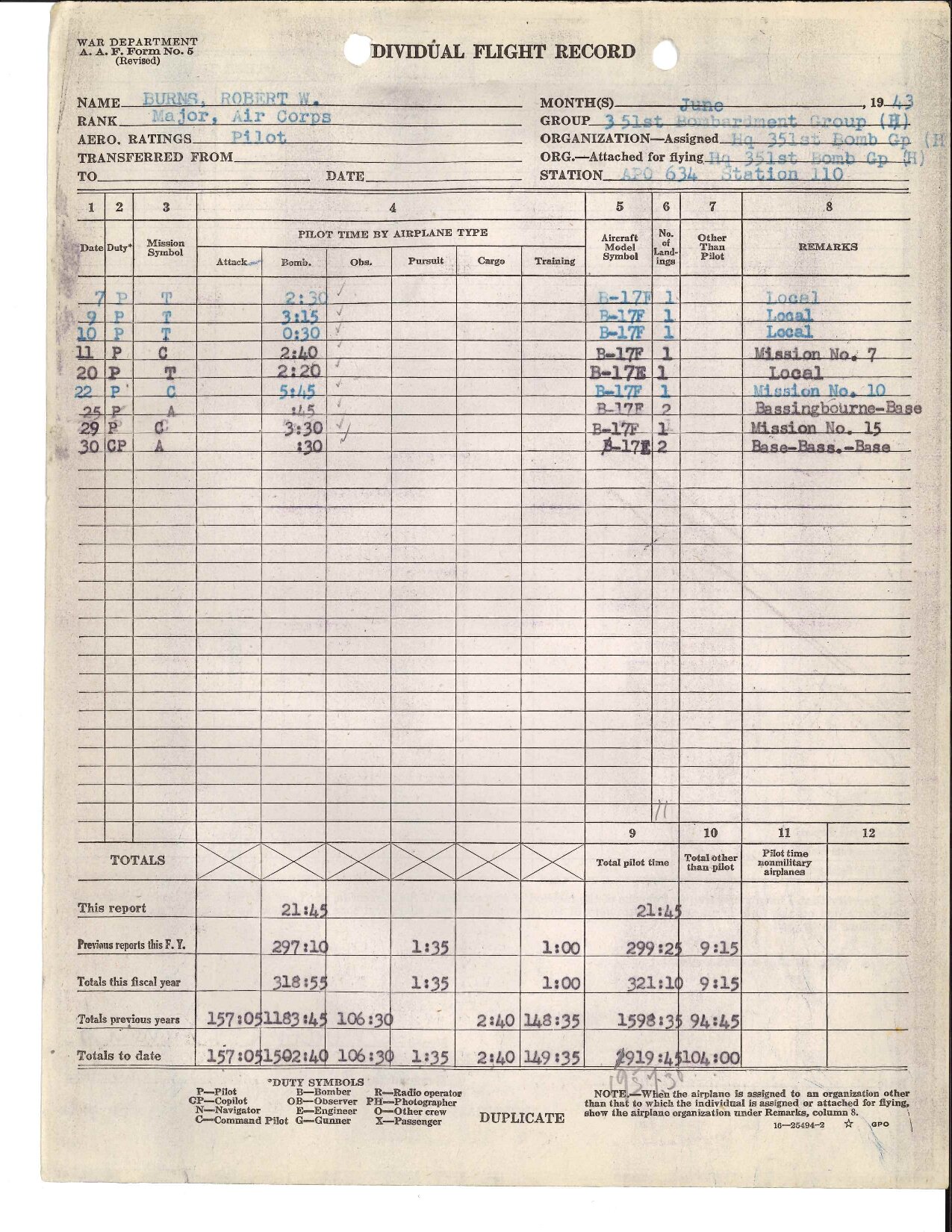
June 1943 Form 5 — the summer he met Ruth, filled with local flying around Polebrook.
Lilford Hall — the 160th Station Hospital — sits four miles from the Polebrook runways. The hospital visits in this story happened between entries like these: the local flying of the group’s first English summer.
View all flight records →