AAF Form No. 5: The Record Behind the Flight Log
How to read an Individual Flight Record — fields, codes, and conventions
Every United States Army Air Forces officer who flew maintained an AAF Form No. 5 (Individual Flight Record) — a monthly ledger of every flight taken, certified under oath by a commanding or operations officer and submitted up the chain of command. For Bob Burns, these forms accumulated from his first solo in 1939 until his retirement as Major General in 1970: 303 monthly forms spanning the War Department era, AAF disbandment, USAF independence, and the jet age.
Each form carried the weight of a legal affidavit. The certifying officer — typically the group's operations officer or the commanding officer — signed it monthly, attesting that the entries were accurate. The form was then forwarded to higher headquarters, where it entered the permanent file. This was not bureaucracy for its own sake: in wartime, the document governed pay, rank, and whether a man's family would receive benefits if he did not come home.
The schematic below represents the layout of the standard WAR DEPARTMENT A.A.F. Form No. 5 (Revised) as it appears throughout Bob's WWII-era records (1942–1945). The form's structure was standardized by the Government Printing Office — the GPO mark at the lower right indicates a federally printed standard form rather than a unit-local template.
Schematic represents the WWII-era standard form. Column widths are approximate; actual forms used narrow printed columns for dates and aircraft types.
The Duty column is the form's most operationally revealing field. A single letter encoded the pilot's role and authority level on each flight:
This month includes Mission #29 — the Schweinfurt-Regensburg raid, August 17, 1943 — one of the most costly missions in 8th Air Force history.
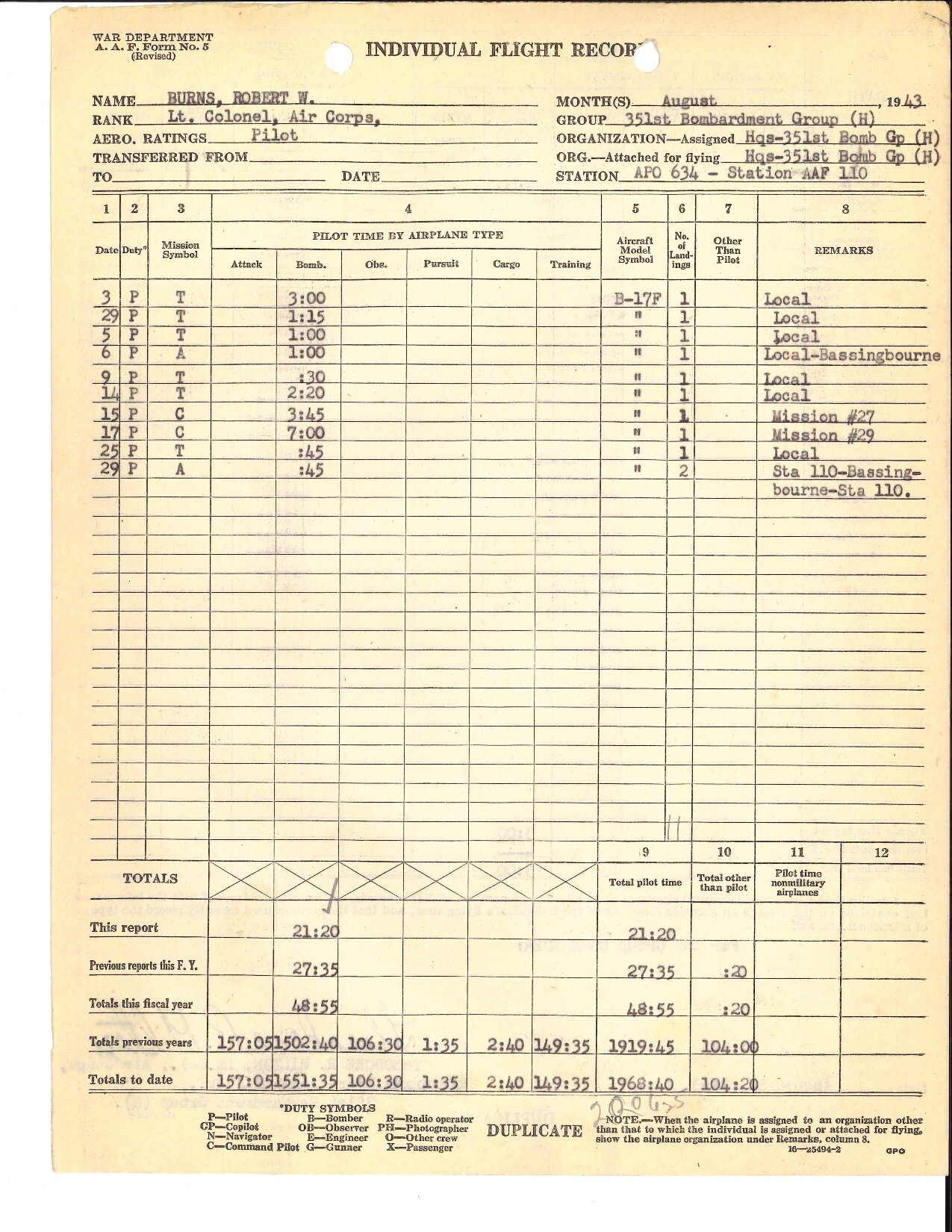
Front — flight entries
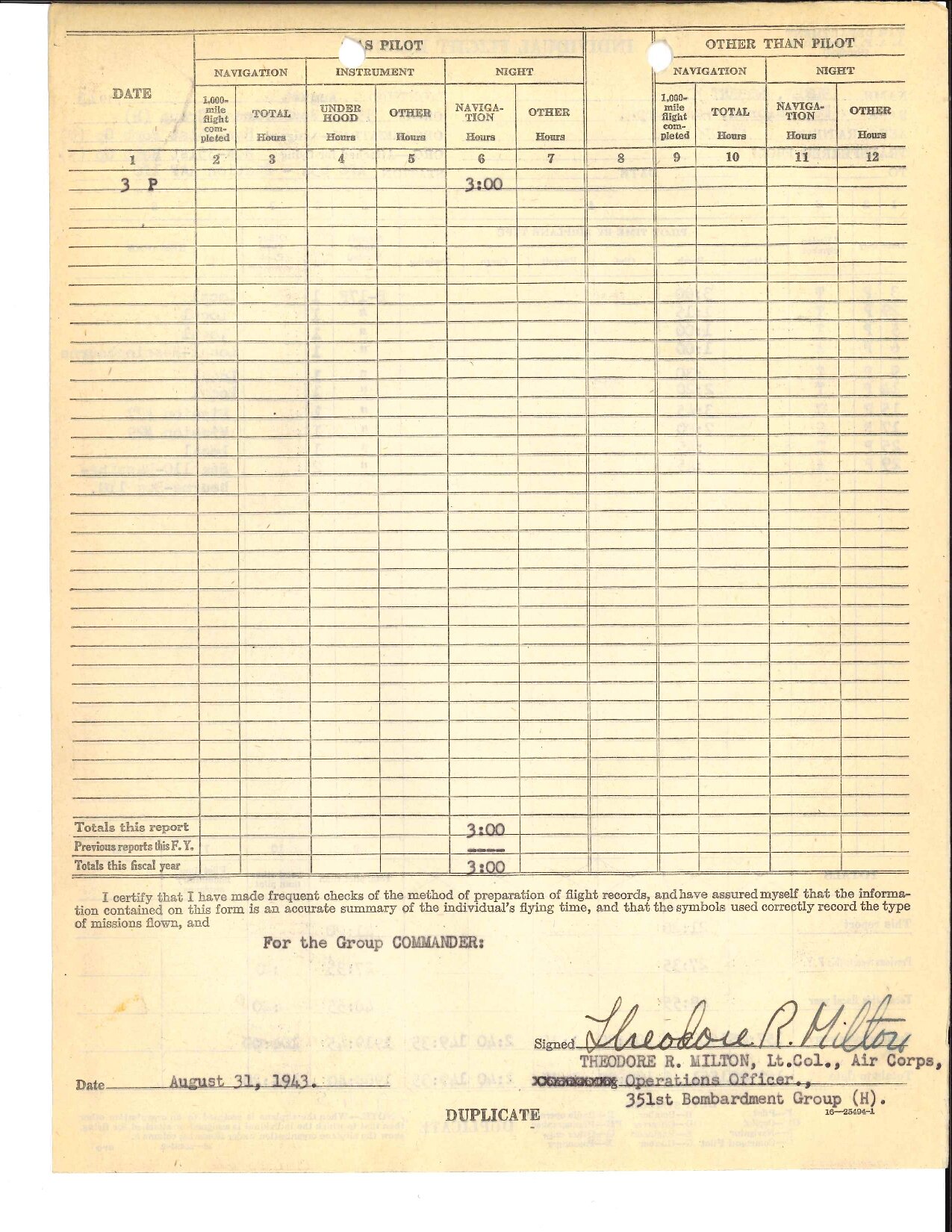
Back — monthly totals & certifying signature
August 1943 · AAF Form No. 5 (Revised) · Major Robert W. Burns · 351st Bomb Group (H), Station 110, Polebrook, England
Form header: "WAR DEPARTMENT A.A.F. Form No. 5 (Revised)" — A.A.F. = Army Air Forces, the WWII-era designation of the U.S. Army's air arm.
"War Department": Legally correct here in 1943. The National Security Act of July 26, 1947 restructured defense; the USAF became independent September 18, 1947, and form headers changed accordingly.
Identity block: Name, rank, aeronautical rating, month/year, group number, organization assigned, organization attached for flying, and station.
Station — "110": AAF Station 110 was Polebrook Airfield, Northamptonshire, England. The 351st Bomb Group occupied Polebrook from April 1943 through the end of the war.
Duty column (Col. 2): "C" = Command Pilot. On combat missions #27 (Aug 15) and #29 (Aug 17), Burns led the formation as group or division leader.
Mission #29 — Aug 17 — 7:00 hrs: The Schweinfurt-Regensburg double strike. Seven hours reflects a deep unescorted penetration into Germany. Of ~376 B-17s launched, 60 were shot down.
Aircraft type column: "B" designates Bombardment (heavy). In August 1943 Burns flew the B-17F/G; the model symbol column recorded the specific variant alongside each flight line.
Remarks column: Entries such as "Local," "Bassingbourne," and target names. "Local" denotes formation practice or currency maintenance flights over the base area.
Total pilot time — summary column on the back page. Accumulates all time logged in columns 1–8 where the pilot was at the controls (any duty code other than O).
Total other than pilot — time logged as observer or passenger. Governs flight-pay eligibility separately from command or first-pilot time.
Pilot time — non-military airplanes — a separate running total for any civil or contractor aircraft flown. Rarely used in combat records; more common in postwar and ANG assignments.
Unlabeled column — the header is blank on this form. No use for it appears in the August 1943 record; the column number was likely reserved so a unit could add a title if needed.
Back-page elements not numbered in the column scheme: The back page carries the cumulative rows (This report / Previous reports this F.Y. / Totals this F.Y. / Previous years / Grand total to date), the certifying officer's signature block, and the GPO (Government Printing Office) mark with print-run number — evidence that the form was a federally standardized document, not a locally printed template. For August 1943 the certifying officer was Lt. Col. Ross Milton, Group Operations Officer, 351st BG, who later rose to four-star general.
One of the striking things about these forms is where they were created. In the summer of 1943, as the 351st Bomb Group flew deep into Germany from its base in rural Northamptonshire, someone in the group's administrative section was simultaneously maintaining individual flight records for every pilot on base — logging sorties, tallying hours, and preparing the monthly forms for certification. This was not rear-echelon paperwork. It happened in theater, in wartime, under the same operational tempo that sent aircrews over Schweinfurt.
"Otherwise, we were engrossed with the minutia of paperwork, writing letters of regret to the families, efficiency reports, etc. I don't recall having much idle time. But our staff officers' mess was the finest in the UK."
— Gen. Robert W. Burns, recalling life at Polebrook in correspondence with his grandchildren
The paperwork Burns describes — letters to bereaved families, efficiency reports, flight records — was the connective tissue of a combat unit. The group's adjutant and S-1 (personnel) section maintained the Form 5 entries, but the operations officer was the key figure: he had firsthand knowledge of every mission flown, every abort, every training flight, and certified the record monthly.
At the 351st Bomb Group, that certifying officer during much of the 1943 combat period was Major (later Lt. Colonel) Ross Milton, the group operations officer. Burns first encountered Milton on arrival at Polebrook:
"After landing, I was met by Maj. Ross Milton, group ops, who took me to our quarters. He told me that they were worried that I hadn't made it across the pond because they had received no word from me the whole time I was enroute."
— Gen. Burns, describing his arrival at Polebrook in spring 1943
Milton's signature appears on Burns' Form 5 records throughout this period, an administrative thread connecting the two men across dozens of missions. Milton would go on to become a four-star general in the postwar Air Force — the same career trajectory Burns himself followed.
"Willie announced that he, I, and the ops man, Ross Milton, would rotate as group leader. This was the routine for about three months or so when 8th AF decreed that group commanders and deputies would only fly when his group was either leading his Division or the entire 8th."
— Gen. Burns, describing the command rotation system at the 351st BG
This rotation — Hatcher, Burns, Milton — is documented in the Form 5 records. Each month's Command Pilot entries reveal who led the group on which missions, a detail that would otherwise exist only in mission records and debriefings. The seemingly dry administrative form preserves the operational tempo of the group's leadership in a way no narrative account fully captures.
"So, between being shot at, we lived as well as our resources and imagination could provide."
— Gen. Burns, on life at Polebrook — ice cream frozen at 18,000 feet, scotch from Scotland, dances with local women bussed in from the surrounding towns
Bob Burns' flight records span four distinct administrative eras, each reflected in the form itself — its header, its column structure, and its certification language. The archive now spans all four eras in full, from his first 1939 cadet flights to his final 1970 summary.
The National Security Act of July 26, 1947 and USAF independence on September 18, 1947 changed the form header from "WAR DEPARTMENT" to "DEPARTMENT OF THE AIR FORCE." Burns' postwar career spanned ten assignments across three continents over 25 years. These forms are now fully digitized in the archive.
Form No. 5 is a flight log, not a career history. It records what was flown and certified in that calendar month. It does not record training curricula, unit equipment lists, or the aircraft an officer was qualified on but didn't happen to fly that month. This distinction matters when using the archive as a reference.
The Flight Log and its aircraft counts reflect only documented aircraft — types that appear by designation in a Form 5 entry in the database. Curriculum-context aircraft shown on career phase pages (such as the Training Phase) are visually distinguished — they are known from context but are not named by designation in a surviving Form 5 line.
Bob's flight records are now fully transcribed, 1939–1970. Two kinds of thinness remain. A handful of monthly source sheets are physically missing from the surviving scans — March–December 1967 and September–November 1969 — and some early months (the 1939 cadet training and parts of the Canal Zone years) survive only as summary forms that recorded cumulative totals without individual aircraft lines.
Any figure labeled "documented" reflects aircraft types that appear by designation in a surviving Form 5 line; a few additional types are known only from those summary-form or missing-sheet periods and are shown as "context."
On the morning of July 12, 1973, a fire broke out in the sixth floor of Building 228 at the National Personnel Records Center in St. Louis, Missouri. The building housed the official military personnel files of millions of veterans. By the time firefighters contained the blaze, an estimated 16 to 18 million Army personnel records had been destroyed. There was no water suppression system in the building, no duplicate copies, and the records were stored on highly flammable paper. The loss is considered one of the greatest archival disasters in American history.
Bob Burns' official records at NPRC are therefore likely among those destroyed or compromised. His WWII service fell squarely within the affected period.
Career military officers — especially those who rose to senior rank — routinely maintained personal copies of their official records. Promotion boards, assignment requests, and fitness reports required officers to submit records on short notice; keeping personal files was practical necessity, not unusual foresight.
The forms in this archive are those personal copies: the originals Bob Burns kept throughout his 31-year career and left with his family. They were never in Building 228. For many veterans of this era, the family archive is the only surviving record.
This is the reason family archival projects like this one carry historical significance beyond the family itself: they recover what federal preservation failed to protect.