📖 Major Burns' First-Person Account
The next memorable mission came in September, when our division went to Nantes, France to bomb a German [submarine mother ship] at harbor there. And it was bitched up from the start. The plan was to take off before dawn, proceed to the south coast of England, form up there and go straight south to Nantes.
For a variety of reasons, only two groups showed up at the coast, us and the 92nd Group. And I was the Division leader. Having only two groups instead of the expected 10 or so, I debated the wisdom of going on, but having received no recall, I pressed on.
Our briefed bombing altitude was 24,000 feet and over France, we had to be able to visually sight the target. Crossing the channel, cloud cover kept us going lower and we wound up bombing at about 16,000 feet.
Then we turned to retrace our route back. A short time after the turn for home, we encountered a lower cloud deck and beyond it, I could see German fighters swarming off the ground and I knew they would be waiting for us to penetrate that cloud mass and emerge on the other side in disarray.
I decided to escape this trap by flying toward the clouds as long as I could, then make an abrupt 90 degree turn to the left, let down to 3 or 4 thousand feet to be in the haze layer over the sea. Then, when we were clear of the Brest peninsula, take up a course to England.
When we got down into the sea haze, both Gable and I went to the nose and each of us handled a gun, looking for any stray fighter who might find us. I did it because I had never had a shot at a fighter and I looked forward to it.
After about 20 minutes after our turn to sea, out of the murk came about twenty or so fighters in formation headed directly at us. The closing speed was so great that neither I nor Gable had time to fire a shot and the fighter force was in the same boat.
Then, unmolested, we went back to England, about 1 and a half hours overdue. On landing, when I got out of the airplane, my Div. Commander, Bill Gross, was waiting. He said, "What happened, boy?" And I told him. He had no fault to find, and got me awarded the Silver Star medal.
I have always suspected that if I had lost a few birds in the channel for running out of fuel, I would have been sent home in chains.
About the Silver Star
The Silver Star is the third-highest military decoration for valor in combat. Major Burns received this honor for exceptional leadership and quick tactical thinking when faced with an ambush situation. Rather than following the expected route where German fighters waited above the clouds, he made the bold decision to take his small formation on an unexpected low-level detour through sea haze, saving all aircraft and crew despite being critically low on fuel.
📚 Historical Context
- Target: German submarine mother ship (tender) at Nantes harbor, France. These vessels serviced U-boats operating in the Atlantic.
- Mission Date: September 23, 1943 (Mission #41 for the 351st Bomb Group)
- The Problem: Only 2 of 10 expected bomb groups rendezvoused at the south coast of England — a dangerously small force (approximately 40-50 B-17s vs. planned 200+).
- Weather Complications: Cloud cover forced descent from briefed 24,000 ft to 16,000 ft for visual bombing — more vulnerable to flak and fighters.
- The Trap: German fighters scrambled and climbed above the cloud deck, waiting to catch bombers as they emerged scattered and disorganized after passing through clouds.
- Burns' Decision: Sharp 90° turn westward toward the Atlantic Ocean, rapid descent to 3,000-4,000 ft into sea haze layer, extended detour around the heavily-defended Brest peninsula.
- The Risk: Extended route added approximately 90 minutes to return flight, with fuel gauges reading dangerously low. Any headwinds or navigation errors could have forced ditching in the Channel.
- Clark Gable: Hollywood legend (Gone with the Wind, It Happened One Night) was flying combat missions as aerial gunner making training films. Age 42, could have avoided combat entirely.
- The Encounter: Formation of ~20 German fighters passed head-on at combined closing speed of 600+ mph — too fast for either side to engage.
- Result: All aircraft returned safely, landing 1.5 hours overdue with near-empty fuel tanks.
🎯 The Tactical Genius
What made Major Burns' decision remarkable was not just the evasive maneuver, but his ability to:
- Read the Battlefield: Spotted German fighters "swarming off the ground" and immediately understood they were setting an ambush above the clouds.
- Act Decisively: Made a split-second tactical decision without time to consult higher command or wait for instructions.
- Calculated Risk: Weighed certain ambush vs. possible fuel exhaustion, choosing the option that gave his crews the best chance of survival.
- Navigation Under Pressure: Led formation at low altitude in poor visibility (sea haze) without modern GPS, maintaining course for 90+ minutes.
- Command Presence: Kept formation cohesion during unexpected maneuver — crews trusted their Division Leader enough to follow him on the unplanned detour.
- Maintained Discipline: Didn't break radio silence to explain the maneuver, avoiding tipping off German intercept stations.
Division Commander Bill Gross's response — "He had no fault to find" — speaks volumes. Burns had exceeded his fuel margins, deviated from the flight plan, and brought his formation back 90 minutes late. Yet Gross recognized that avoiding the ambush was the right call, even if it meant bending the rules. That's leadership recognizing leadership.
🗺️ Mission Route & Tactical Maneuver
Tactical Overview: The red dashed line shows the briefed route (England → Nantes → England). The gold solid line shows Major Burns' evasive maneuver: sharp turn west toward the Atlantic, descent to 3,000 ft in sea haze, extended detour around the Brest peninsula to avoid the fighter ambush waiting above the clouds. This added approximately 90 minutes to the return flight but brought all aircraft home safely.
Official Flight Record
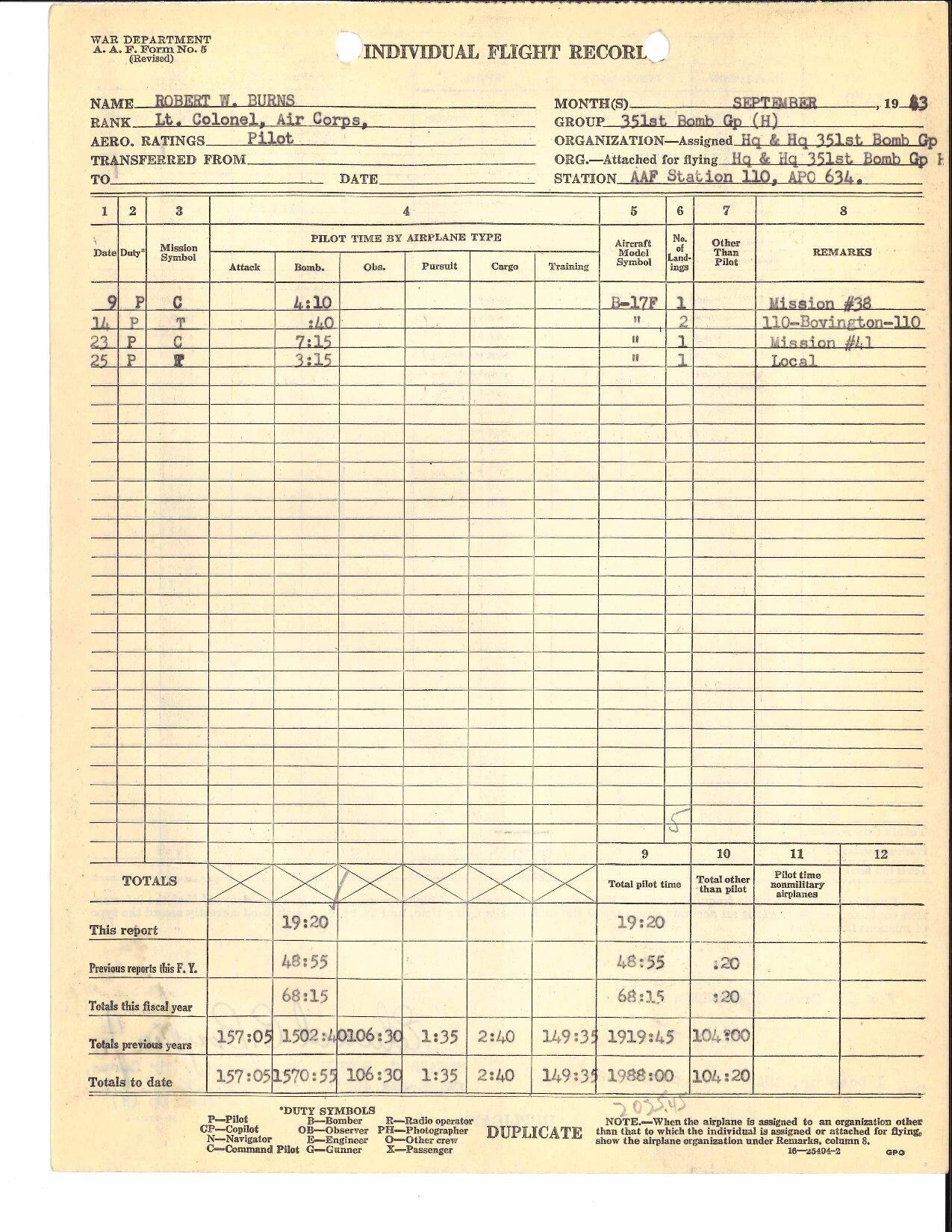
AAF Form 5 for September 1943 showing Mission #41 on September 23 — 7:35 hours logged as First Pilot
(Click image to view full size)
Note the 7:35 flight time — significantly longer than a typical Nantes mission would require. The extra time reflects the extended low-level detour over the Atlantic to avoid the German fighter trap. A direct return would have taken approximately 6 hours; the evasive route added 90+ minutes.
From the Flight Records
Confirmed
September 1943 — Individual Flight Record (Form 5), AAF Station 110 (Polebrook). Mission #41 on September 23rd: 7 hours 35 minutes — the detour over the Atlantic is visible in the duration.
Bob's Form 5 for September 1943 shows 455 minutes of first-pilot time on a B-17F on the 23rd, noted "Mission #41." The 7:35-hour duration — roughly 90 minutes longer than a direct routing would require — reflects the evasive detour Bob led over the Atlantic to evade the German fighter ambush.
View all flight records →📷 Mission Photographs — September 23, 1943
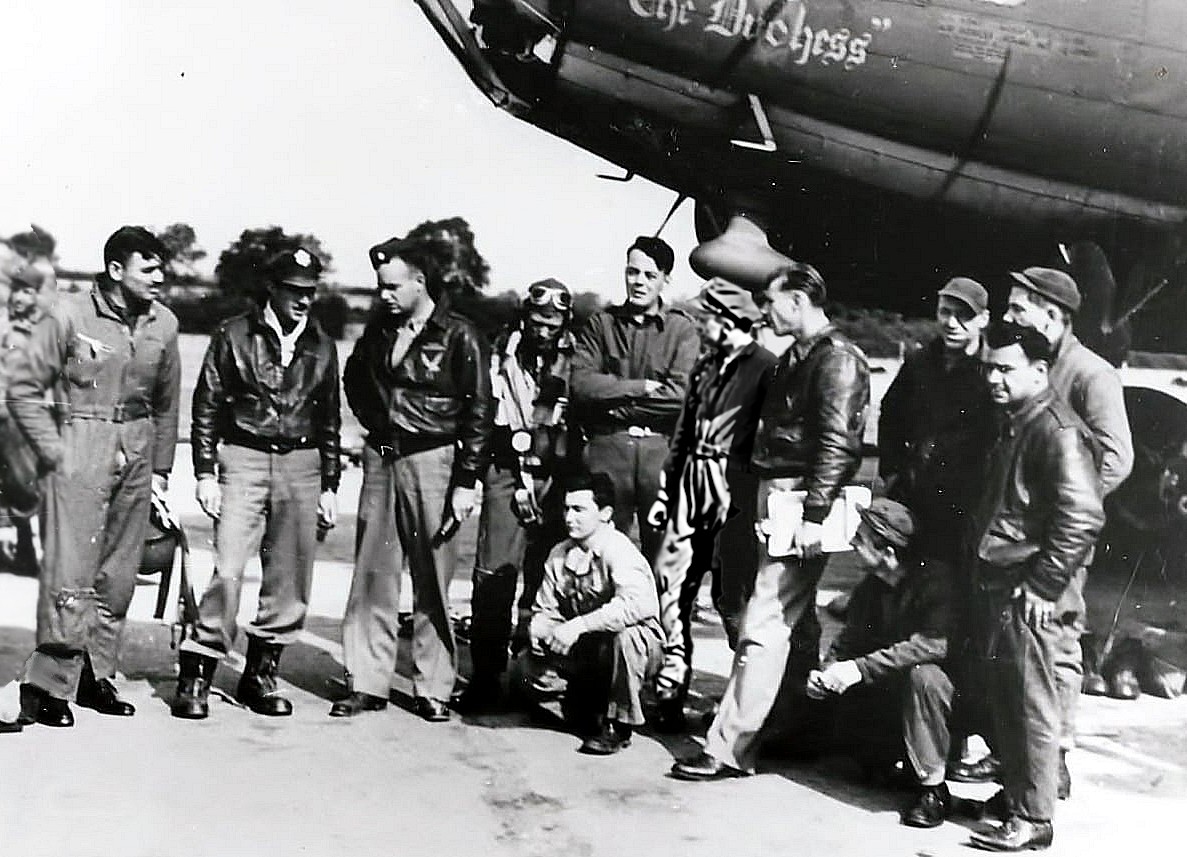
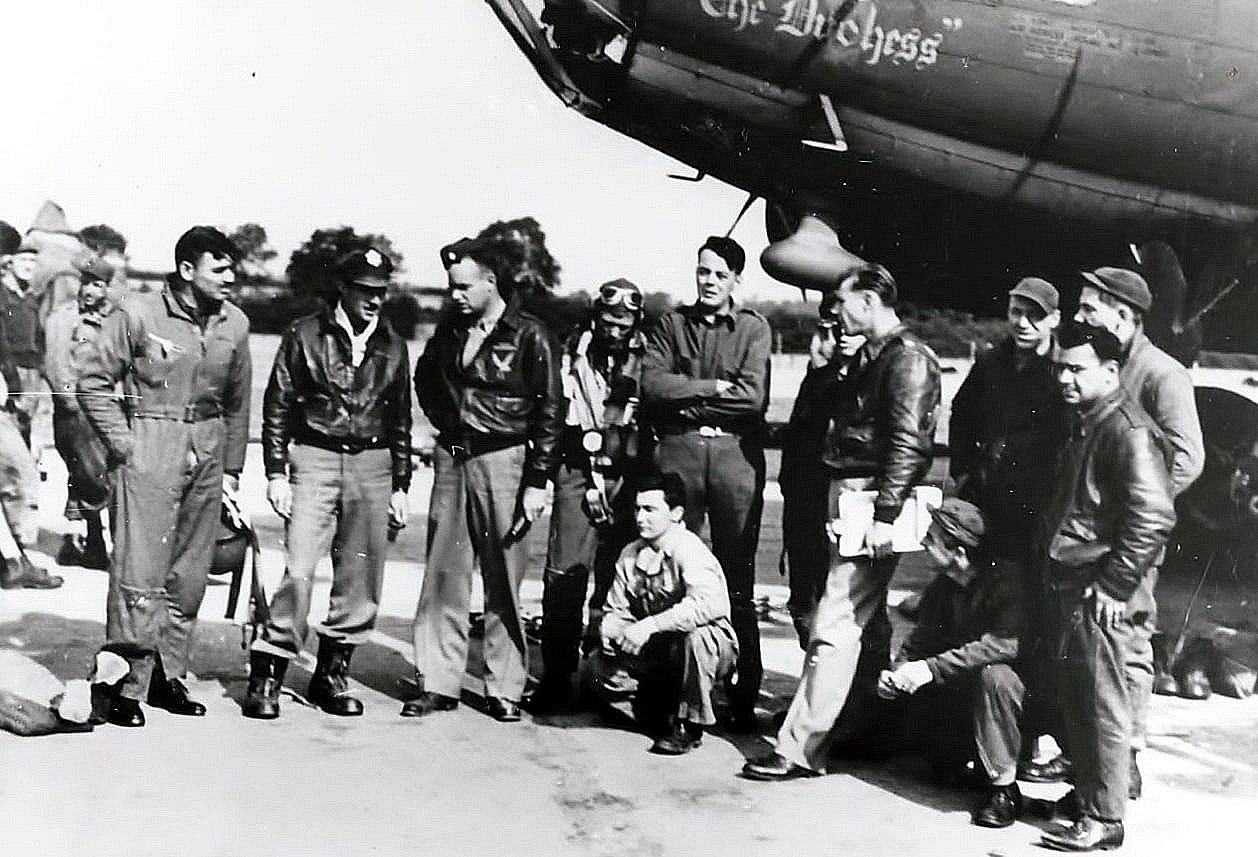
The Duchess and Her Crew — June 22, 1943
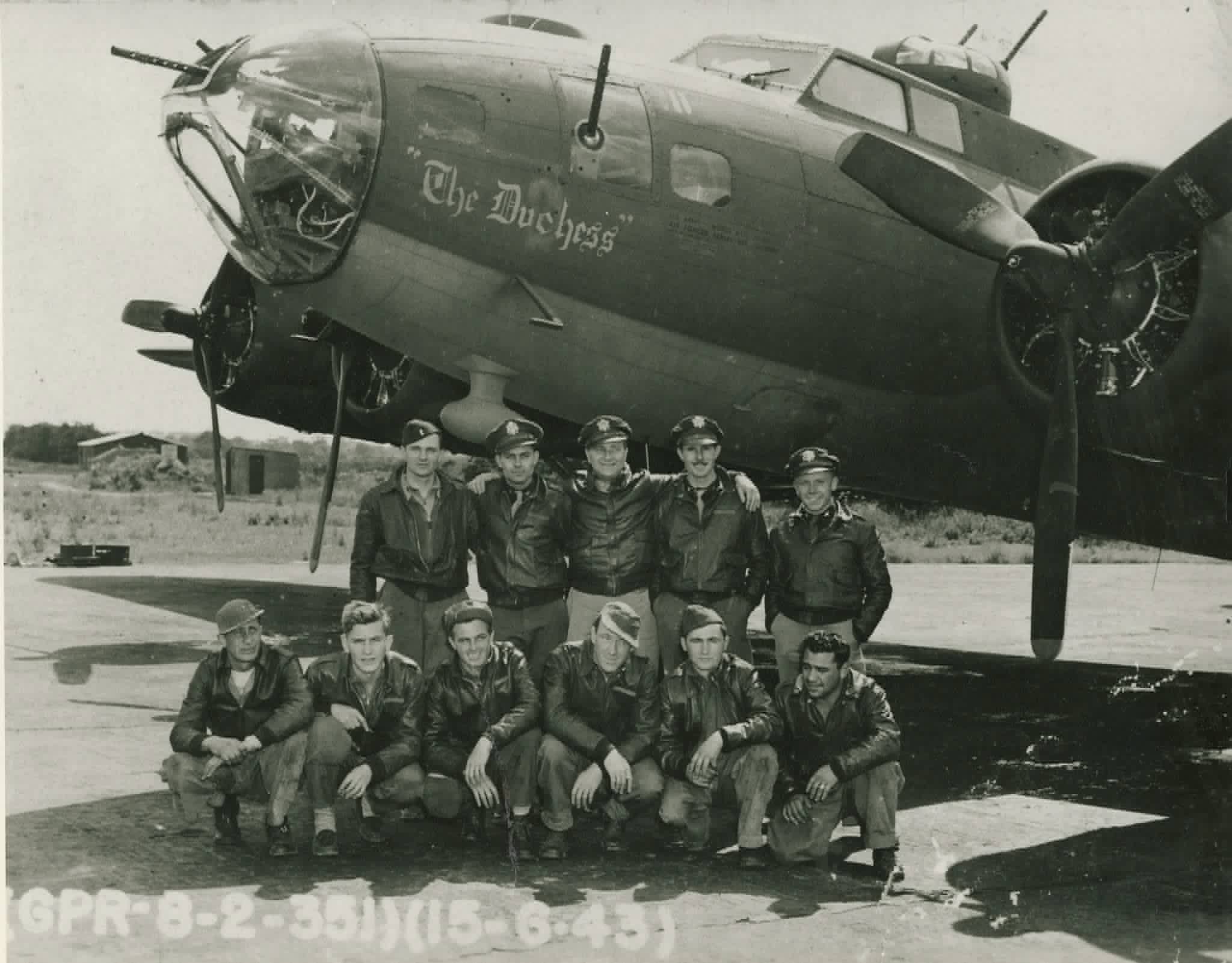
Crew Portrait — After the Mission
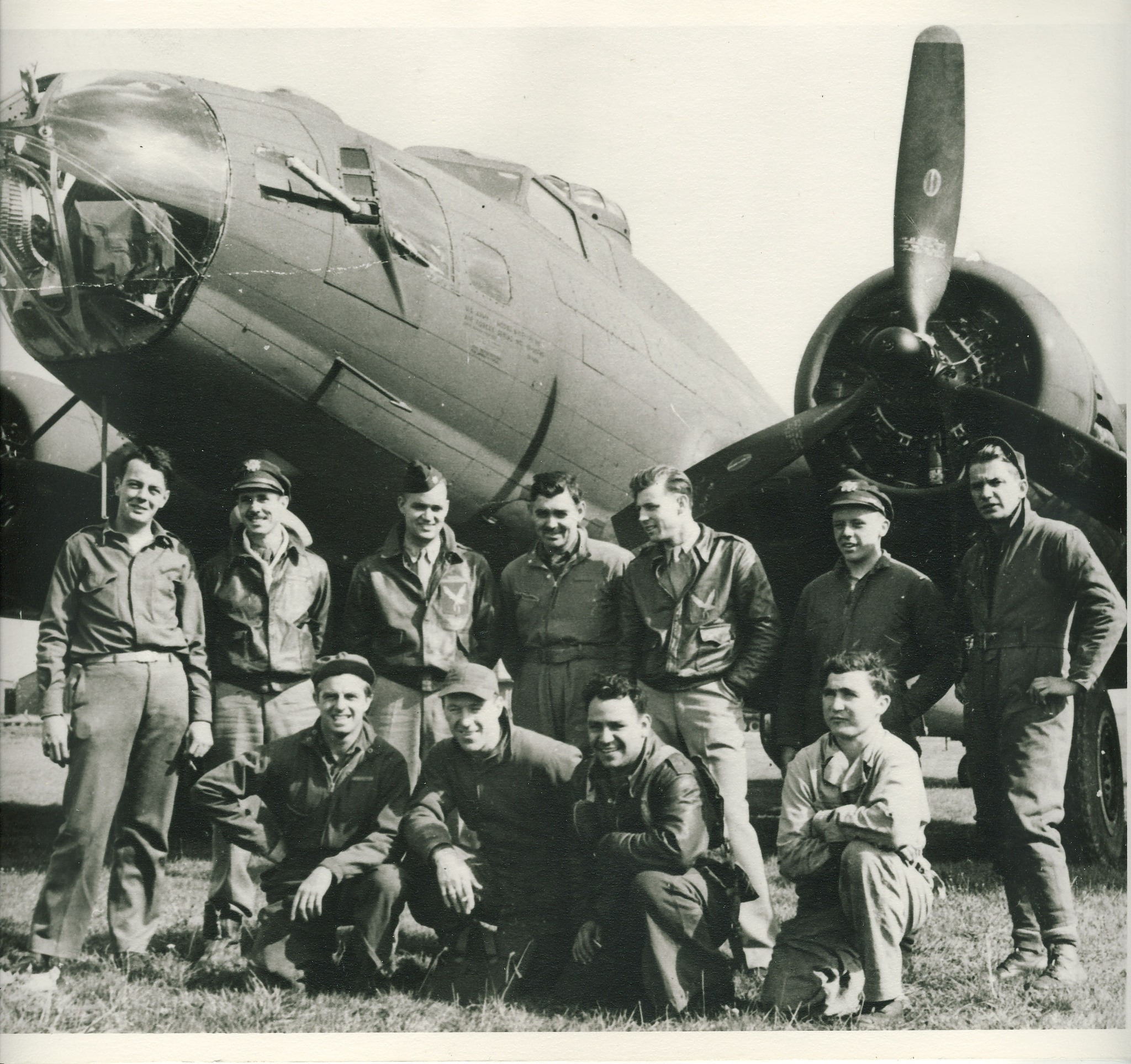
After the Mission — Gable and Burns at The Duchess
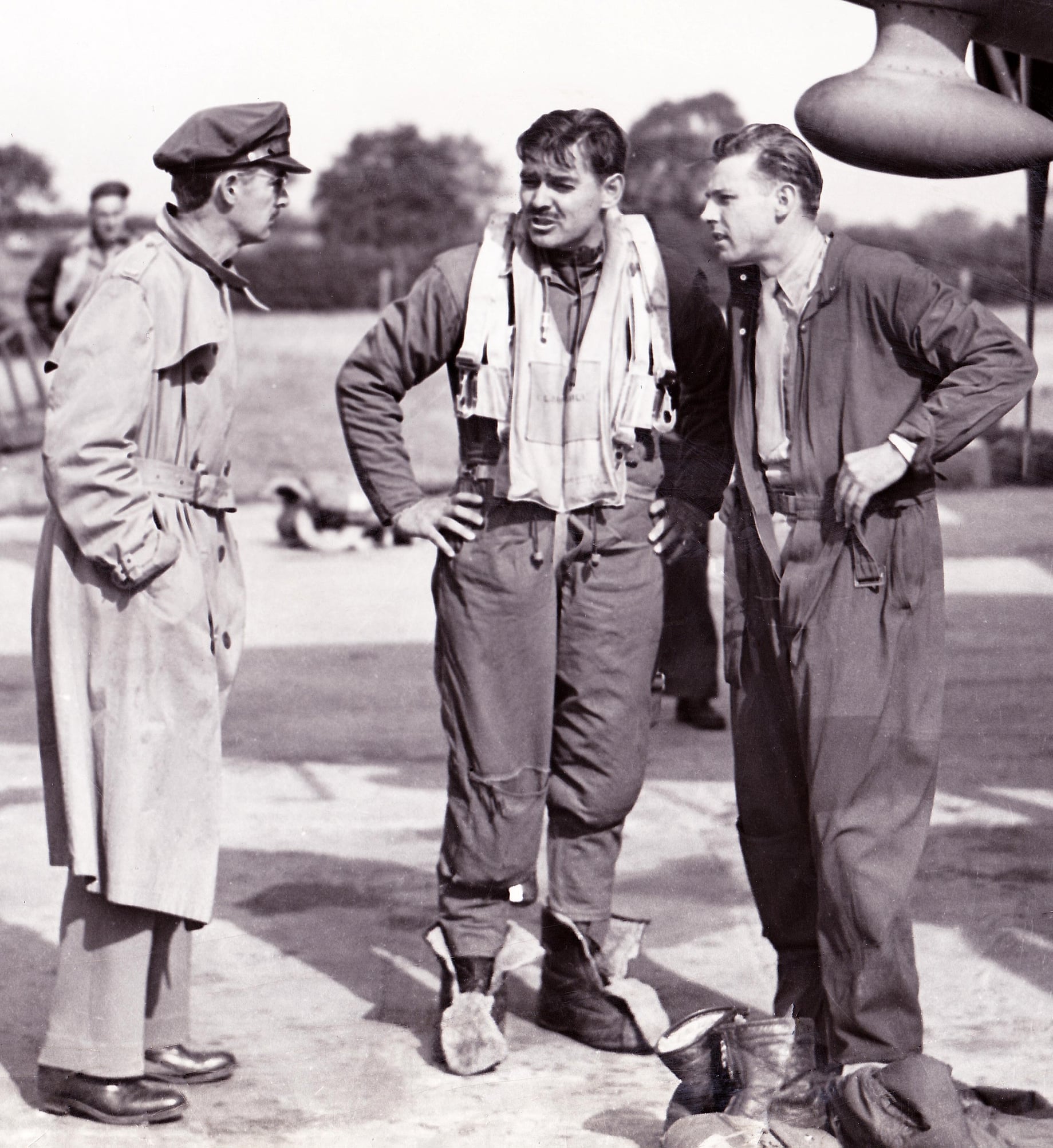
Aircraft Identification Note
The formal crew portrait above has circulated widely under this official AAF caption:
"Captain Clark Gable and the crew of B17F 'Duchess' after completing his 5th and final mission over Nantes, France September 23rd 1943 for which he was awarded the Air Medal. 351st Bomb Group RAF Polebrook."
The identification is incorrect. The aircraft visible in the background of the formal portrait is not The Duchess (42-29925). The serial number reads:
Serial 42-30785 was assigned to the 351st Bomb Group on September 23, 1943 — the same day as the Nantes raid — and was likely parked on an adjacent Polebrook hardstand when the crew assembled for the portrait. It flew only one combat mission (October 4, 1943) before being shot down over Germany, crashing near Langensebold, approximately 16 miles east of Frankfurt. Seven crew members survived as POWs; three were killed in action. Its loss is documented in MACR 908.
The two informal photographs are correctly associated with The Duchess (42-29925) — they were taken beneath that aircraft's nose art after landing.
A Wire-Service Caption Names Burns
The post-mission crew portrait was distributed to American newspapers by International News Photos. The print's reverse carries three contemporaneous stamps — "International News photos," "Passed for publication 25 Sep 1943," and censor number 285399 — and the printed wire caption identifies every man by name, rank, and hometown. Bob is named in the back row:
"… pictured standing in front of the Flying Fortress 'Duchess' after the successful US 8th Air Force (ETO) raid on Nantes (France) the morning of September 23rd are, back row, L to R: Lt James O Bradley, Cincinnati, Ohio; Captain John Carraway, Raleigh, N.C.; Major J R Blaycock, Council Bluffs, Iowa; Captain Clark Gable, Hollywood, Cal.; Lt Col Robert W Burns, Ecru, Miss.; Lt David Palmer, Seattle; Staff Sergeant Stephen Schmitt, Chicago, Ill. Front Row, L to R: Staff Sergeant William J Mile, N.Y.C.; Master Sergeant Fletcher Cupp, Carthage, Mo.; Staff Sergeant Frank Dillinbeck, Spokane; Technical Sergeant Clyde L Eisenhart, York, Pa. … the crew of 'Duchess' aboard which Gable has just completed his fifth mission and thereby earned the Air Medal."
Transcribed from the print's reverse; crew members' street addresses omitted for brevity.
Cleared by the censor and published two days after the raid, this is independent, third-party documentation — a wartime press release — that places Lt. Col. Robert W. Burns on The Duchess with Clark Gable on September 23, 1943. It corroborates Bob's own account and his Form 5 entry for the mission.
Doug Palmer adds a detail about the formation that day: his father, 2nd Lt. David H. Palmer, though a co-pilot, flew in the tail of the lead aircraft "to help the [Air Commander] keep the formation together." That places the mission's Air Commander aboard the lead ship — the role Bob filled as he led the group's small formation on the low-level detour through sea haze described above.
Wire caption and identification provided by Doug Palmer — an administrator of the 351st Bomb Group and son of co-pilot 2nd Lt. David H. Palmer — June 2026.
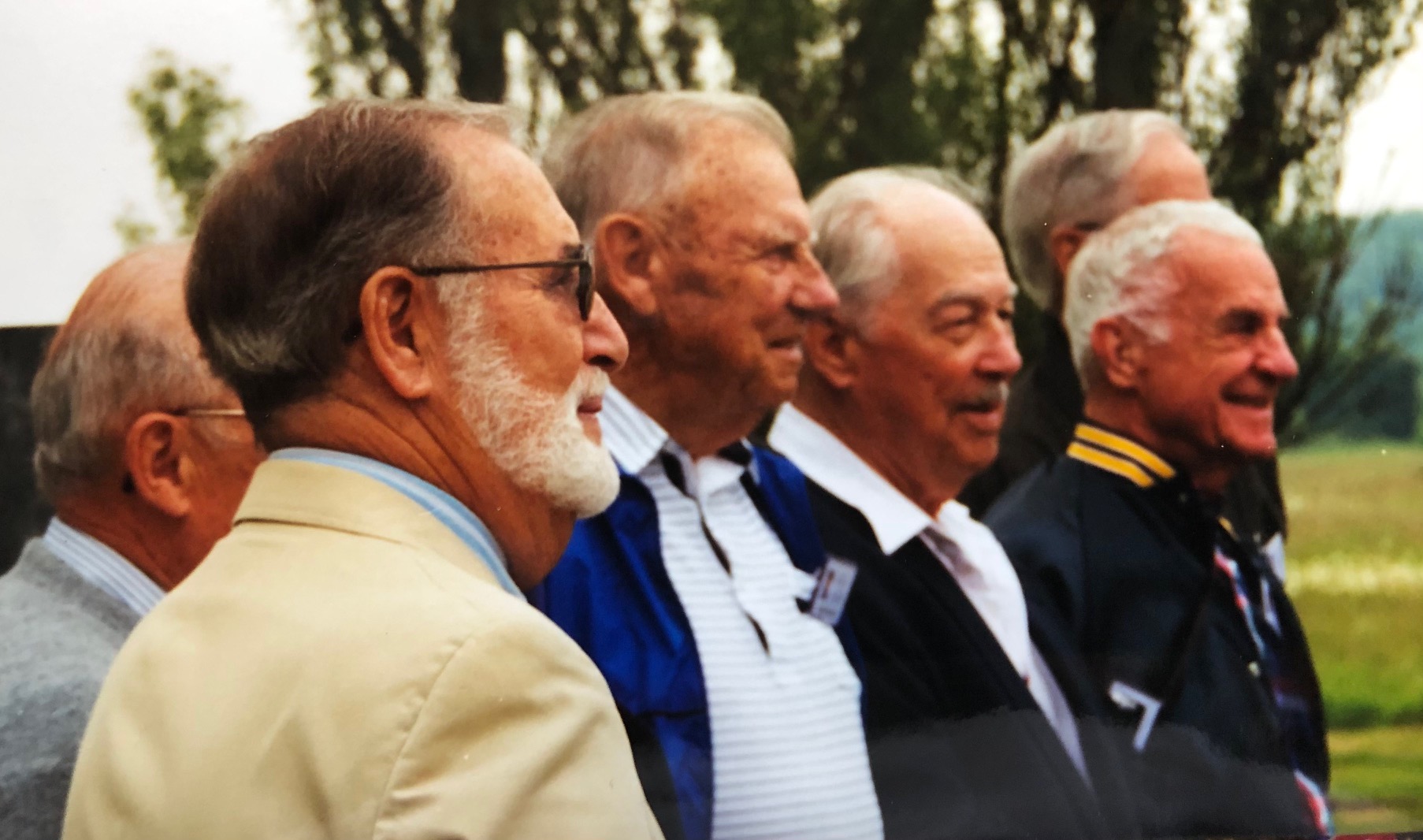
Return to Polebrook — 2000
📚 Sources & Further Reading
- Primary Source: Burns, R. W. (2003, August 5). "Morning Report." Personal communication (email) to family.
- 351st Bomb Group - Mission #41 to Nantes
- American Air Museum - VIII Bomber Command Mission 97
- AAF Form No. 5 Individual Flight Records - Robert W. Burns (National Archives)