Mission 29: Schweinfurt
August 17, 1943 · Roller Bearing Works · flown in The Duchess (42-29925) · a mission room built from the 351st Bomb Group’s complete file and his own words
From his 2003 Morning Report emails. Sixty years on, his numbers hold: the records confirm the four-hour fog delay, the channel attacks, and the toll.
“Schweinfurt is a name I will never forget.”
To begin, the 1st Air Div. [our division] was to go to Schweinfurt, the 3rd Air Division was to parallel our flight plan and bomb the fighter plant at Regensburg, then proceed on to N. Africa. They got off as scheduled but our whole division was totally fogged in, and we didn't get launched until about 4 hours later.
We came under fighter attack crossing the channel, a first time for that. We had limited fighter escort for the crossing but they had all they could handle and then some. We had a running gun battle all the way to the target. Just about every ship used up all its 50 cal. ammo. We bombed, those of us still airborne, and turned for home.
Fortunately, there was little fighter action all the way back but the burning trail of crashed B-17s was a grim reminder of what had happened. As I recall, our fleet had about 360 airplanes of which about 30 or so were shot down. A horrendous toll.
When I landed back at Polebrook, I told myself that there could be no future mission that would be this rough. And for me, this came to be true.
I will also note that, despite the carnage, neither I, nor any crew member on my ship got a scratch, and this held true for the entire war. One of fate's kindnesses.
Every time below is from the group’s own documents. The red band is time over hostile territory.
Couldn’t get anything to eat at Mess Hall from 0200 to 1100, so Red Cross fed us.
Take-off - 1130. (Bob’s account: the division was fogged in and launched about four hours behind the Regensburg force.)
departed in formation at 1211.
Several bursts low at coast – 1347.
gliding down under control with #3 engine on fire. Ten (10) parachutes were seen.
bombs were away at 1503 on a Magnetic heading of 95°. Then the 90° left turn for home.
an A/C in distress on the waterin the Channel and fixes its position for Air-Sea Rescue.
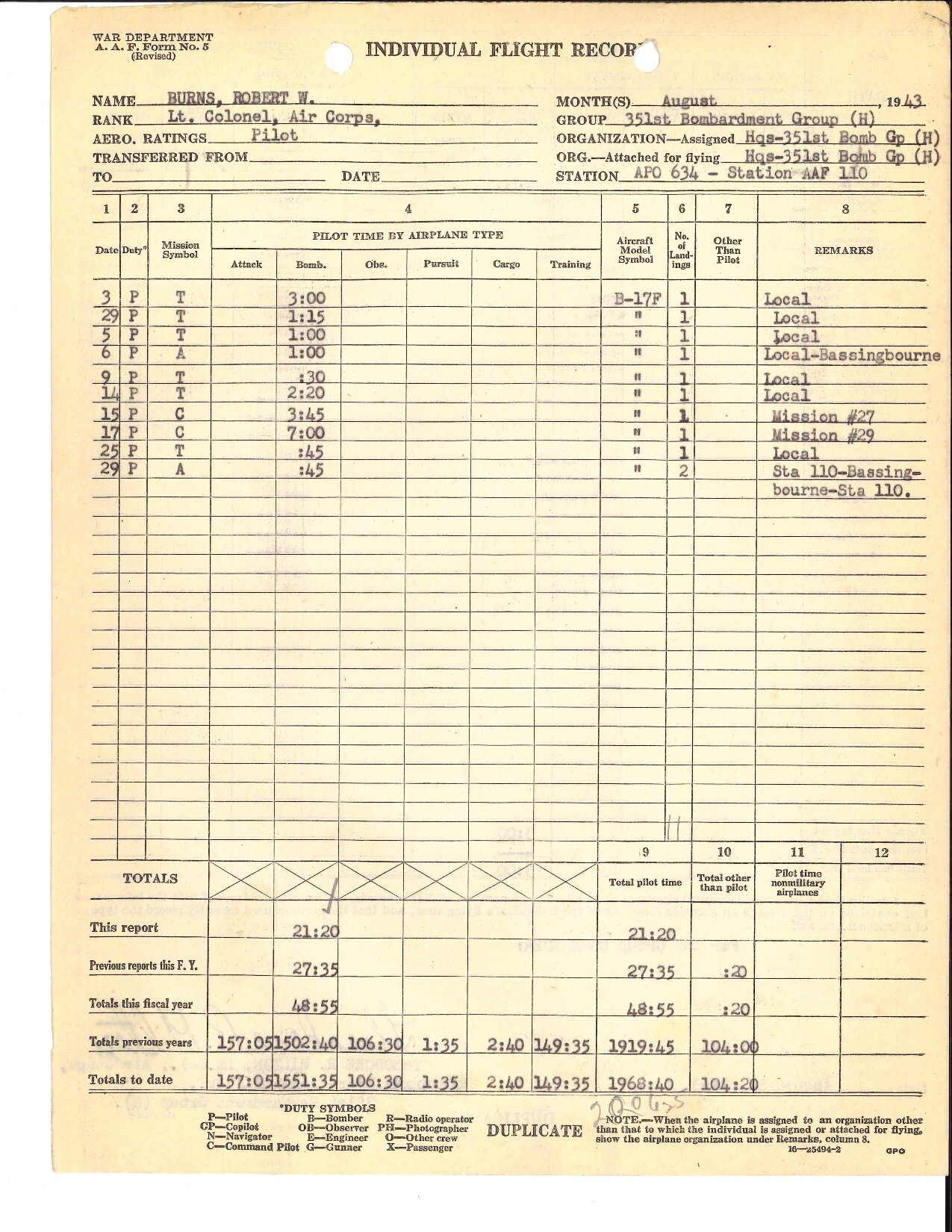
Landed - 1815. His Form 5 logs 7:00 — and then nothing for eight days, as the group rebuilt.
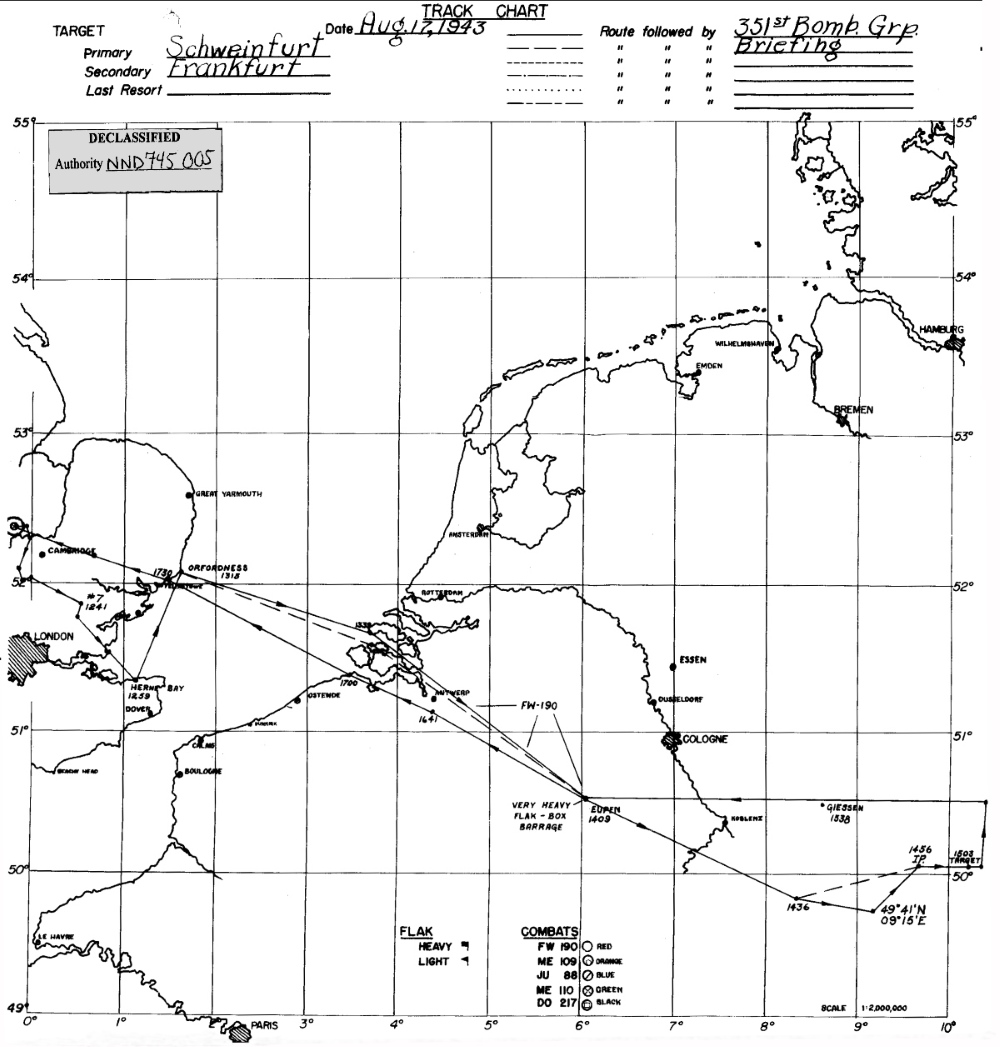
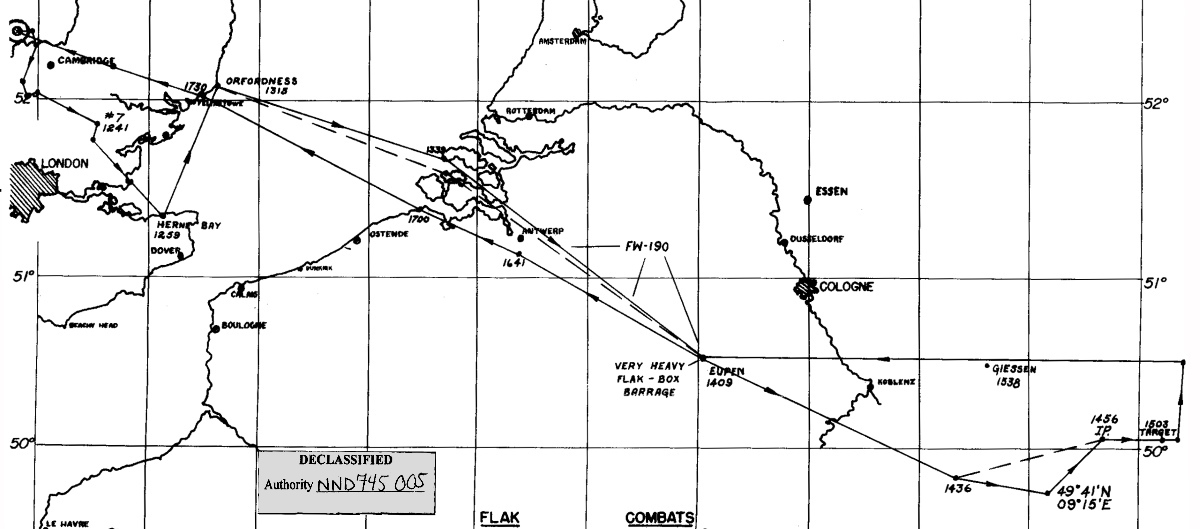
Drawn from the Group Navigator’s narrative and the Flak Report’s waypoints. Red rings are flak as reported; the dark markers are the two losses. The original penciled track chart is in the documents drawer below.
The map renders the table below; every position is from the mission file (the loss of A/C 839 is placed approximately — the file gives its time, 1408, but not its position).
| Leg / Place | What the file says |
|---|---|
| Polebrook → Ramsey → St. Ives → Sandy | Assembly with the 306th and 384th Groups on a line, Ramsey to St. Ives to Sandy |
| Royston → Chelmsford | 101st Combat Wing sighted; wide turn to fall into right echelon |
| Noord Beveland (1339) | Landfall; first flak at the coast 1347 |
| North of Antwerp | Antwerp had moderate flak, low and left |
| South of Aachen | Flak good for height but left— engaged again on the way home |
| Rhine bend near Worms | Course to river midway between Mainz and Mannheim, then the turns south and north to gain bombing interval |
| IP 50°04'N–09°42'E | Red-red flare fired; 90° right onto the target run |
| Schweinfurt (1503) | 210 seconds straight and level; bombs away, magnetic heading 95° |
| Return: Eupen → S. of Antwerp → Knocke | Echelon switch at Eupen; flak at Knocke good for deflection but low |
The Combat Bombing Flight Record of the lead ship, rendered as the instrument panel it describes.
Altitude, True Above Target - 21,400 Feet·
Calculated Indicated Air Speed - 155 M.P.H.·
True Air Speed - 228 M.P.H.
Wind Direction - 280° True·
Wind Velocity - 45 M.P.H.·
Drift - 22°·
True Track - 95°
Approx. Length of Straight Approach - 210 seconds·
Type of Release - Train
Release was in train; the strike photos measured a bomb pattern of 4,704 feet
.
The Photo Intelligence officer’s assessment did not flatter: the main concentration fell short of the intended target
, approximately 2,562 feet west — and approximately half of these bursts are located in what is evidently a residential district located close to the target
. The file records hits on V.K.F. Werks II and the Engelfisher A factory as well. This archive presents the assessment as written; the cost of strategic bombing fell on both sides of the fence.
Fighters concentrated on this aircraft and after about ten passes knocked out the No. 3 engine
. Last seen at 1415, position 50°20'N 07°50'E, gliding down under control with #3 engine on fire
. Ten parachutes seen.
Seen at 1408 on the route in, and later was seen to explode
. Three to eight parachutes reported.
From the engineering officer’s damage report for 42-29925: 7.9 mm. hole through #3 prop. 7.9 mm. through LH [Left Hand] stabilizer to elevator. Shell case hole in leading edge left wing. #4 supercharger change.
Fifteen of the twenty-six returning aircraft were damaged. Bob’s crew, as he wrote, took not a scratch.
| Position | Rank | Name | Squadron |
|---|---|---|---|
| Pilot | Lt Col | Robert W. Burns (Bob) | 351st HQ |
| Co-pilot | Capt | Andrew J. Koszarek | 510th |
| Navigator | 1st Lt | Carl B. Stackhouse | 511th |
| Bombardier | 1st Lt | William A. Winter | 511th |
| Top turret | S/Sgt | Edwin B. Lemley Jr. | 510th |
| Radio | T/Sgt | Albert J. Tokar | 510th |
| Left waist | T/Sgt | Reginald M. Nachreiner | 510th |
| Right waist | S/Sgt | Torlief M. Knaphus | 510th |
| Ball turret | S/Sgt | William J. McMahon | 510th |
| Tail gunner | Capt | Leonard B. Roper | 510th |
At interrogation, the ship’s own debrief comment was filed by her navigator: Seemed as if fighter belt has been moved to interior.
— Lt. Stackhouse. Her gun malfunctions are in the file too: Right waist sear broken. Handle on center nose gun broken. Sights on right nose out of line.
The mission file is written by named men, hours after landing. Verbatim, with their signatures. (The Operations Officer, Major Theodore R. Milton, is the “Ross Milton” of Bob’s Morning Reports — later a four-star general.)
Fighter opposition was extremely heavy. Flak was moderate in intensity and fair in accuracy.
Of the 28 A/C of this Group taking off, 26 bombed their targets and two are missing. There were no abortives.
[Signed] Theodore R. Milton, Major, Air Corps, Operations Officer
The run from the I.P. to target was straight and level and bombs were away at 1503 on a Magnetic heading of 95°.
Navigation was mostly D.R. [Dead Reckoning] and pilotage aided by one Splasher beacon and two "Gee" fixes.
[Signed] Ralph W Menees, Captain, Air Corps. Lead Navigator
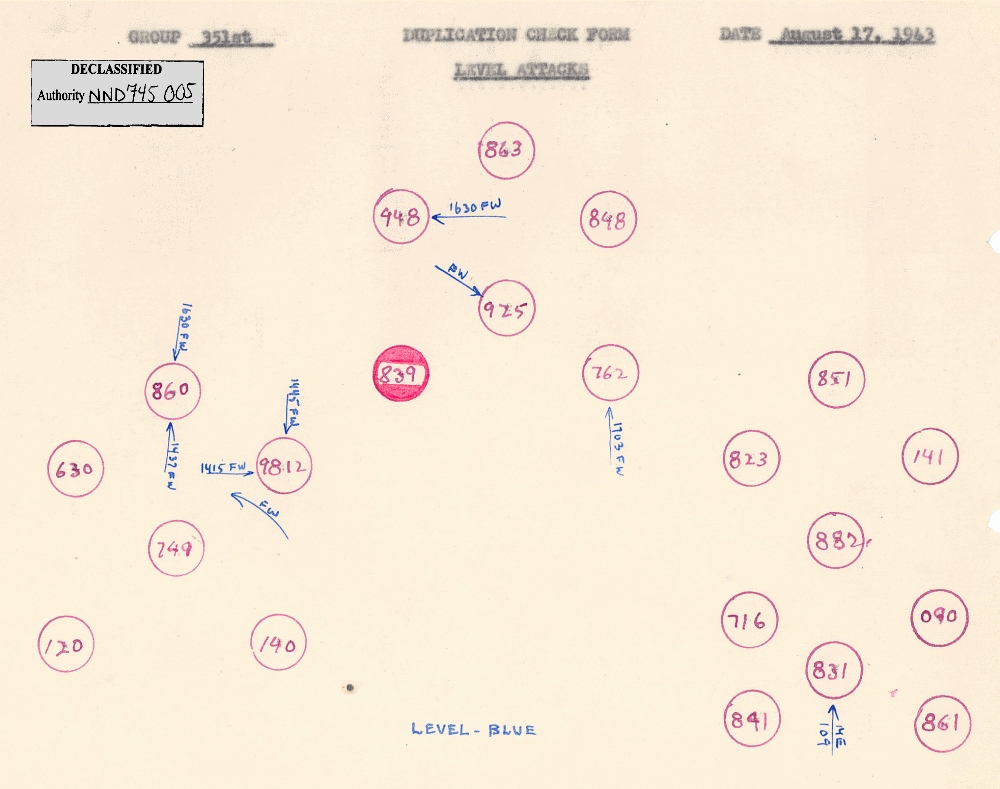
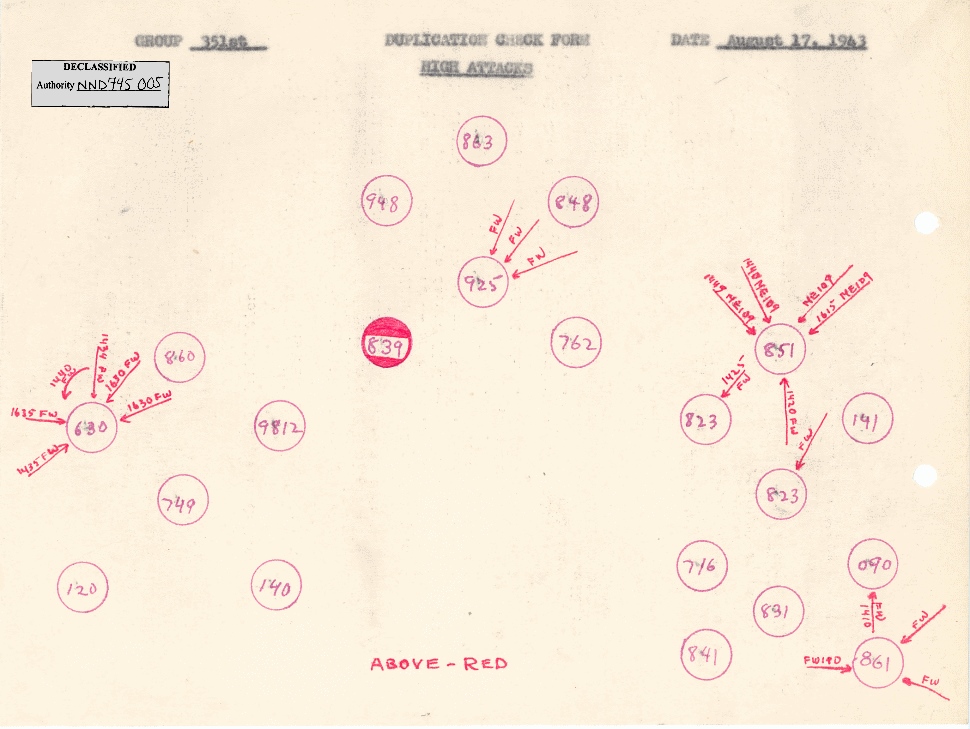
From 150 to 200 enemy aircraft were reported to have been encountered.
Almost all of the attacks were made in formations of from three to twenty or more coming in from all sides and from both above and below, sometimes pressing the attack in to as near as fifty feet before breaking off. Many crew members reported that it was the most determined fighter opposition they had ever seen.
One JU 88 attempted Air to Air bombing above our regular group formation.
[Signed] John L. Scott, Major, Air Corps, Group S-2 [Intelligence]
“Our good formation was the only thing that saved us”. – Lt. Cagle.
The file adds: A similar comment praising the formation was made by three other crews.
Breakfast this morning was bad – eggs were rotten and made some men sick. – All gunners.
See no reason to go over heavy flak areas like Antwerp and Aachen. – Whole crew.
“Let’s get a hot meal if we have to fly like that”. – Whole crew.
Men who had just survived the worst air battle of the war to date, complaining about the eggs. That is what these files preserve that no history book does.
The 351st Bomb Group Association’s volunteers didn’t just transcribe these documents — they reconciled them. Their bracketed editorial note on this mission untangles a contradiction between the J Form, the Load List, and the formation charts: aircraft 868 (Lt. Kern) took off at 1135 and landed twenty minutes later; Kern switched to aircraft 861, took off again at 1208, and had time to catch up to the formation, with good navigation
. Three documents, one truth, recovered eighty years later. This page exists on the shoulders of that kind of work.
The primary documents behind everything above — the Association’s scans, presented as the artifacts they are.
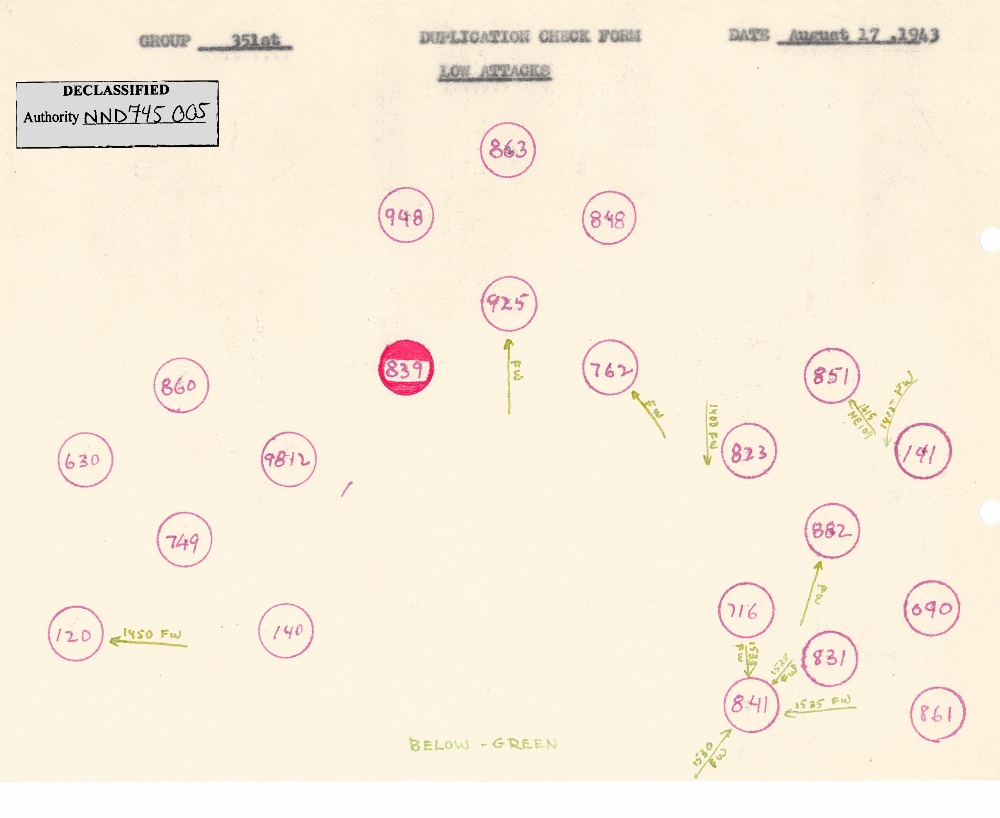
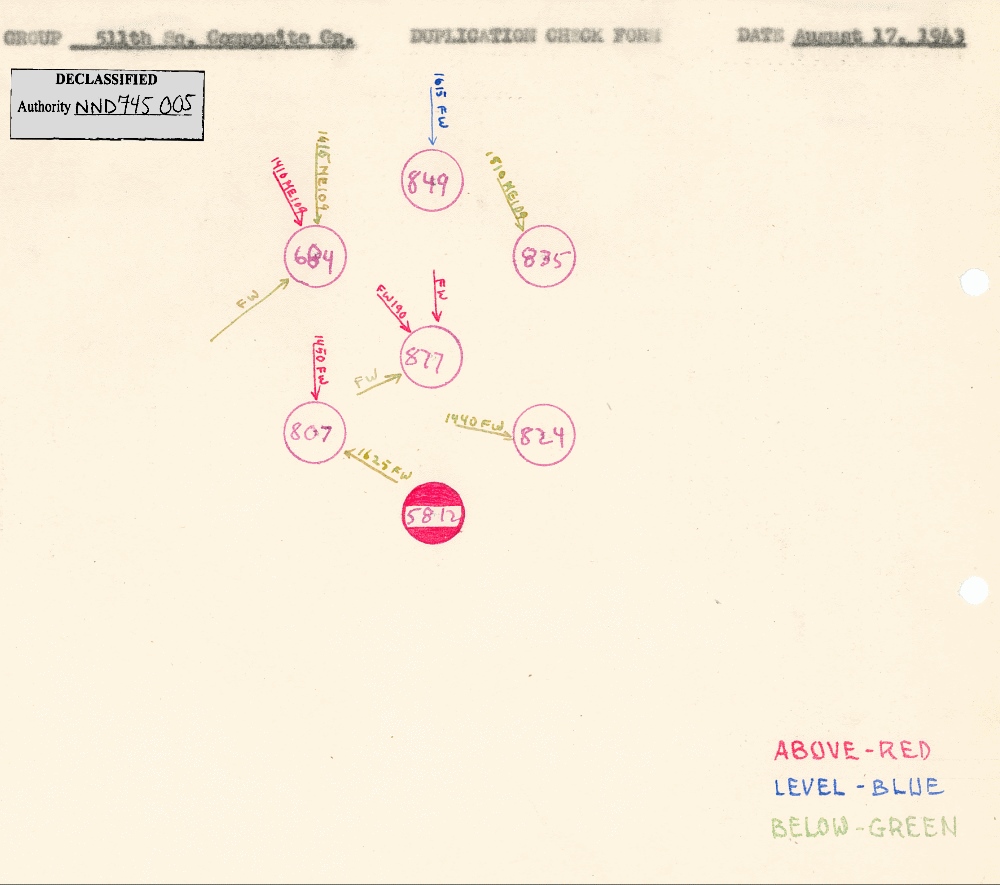
Mission #29 on August 17: 7:00 hours as pilot. Note the eight-day gap to the next flight on August 25 — the group standing down to absorb its losses, integrate replacement crews, and repair its aircraft.
Continue: all 25 Combat Missions · the Morning Reports · Mission 41: Nantes