About This Archive
A digital exhibit of one officer's complete flying career, drawn from primary source records
Who Was Robert W. Burns
Bob Burns entered the Army Air Corps as a flying cadet in 1939, earned his pilot wings at Kelly Field, Texas, and served continuously for 31 years through the Second World War, the early Cold War, and the supersonic era of American airpower. He flew nearly every aircraft the Army and Air Force operated over three decades — from biplane observation aircraft in the Panama Canal Zone to the T-39 Sabreliner at 41,000 feet. He retired in July 1970 as a two-star general, having logged 7,451 hours in the air.
His service encompassed the 8th Air Force's strategic bombing campaign over Europe (combat missions and, from late 1944, command of the 351st Bomb Group at Polebrook, England), postwar National Guard command in Tennessee, Air Defense Command staff assignments, and numbered air force commands in both TAC and ADC. He died at age 87, survived by his wife Ruth — an Army nurse who had served in the same theater of war and whom he married in Greenwich, Connecticut, in 1946. Both are buried at Sarasota National Cemetery, Florida.
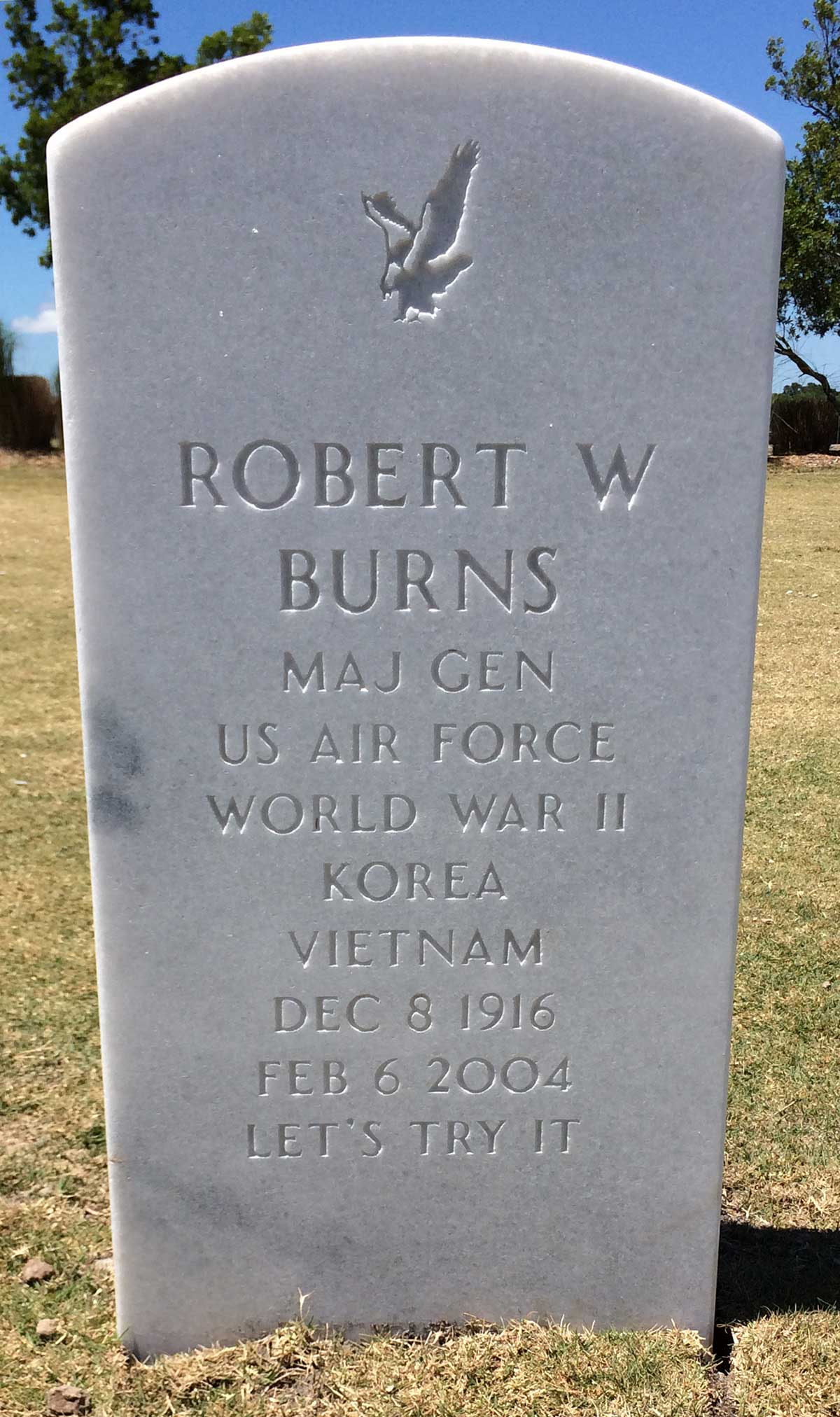
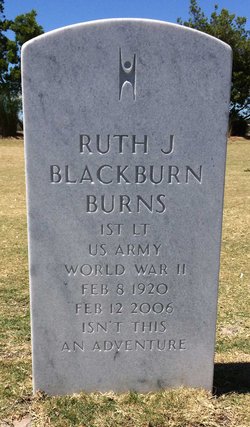
Sarasota National Cemetery, Florida. Bob's children chose the epitaphs together at the cemetery. Andy proposed Bob's — the full original was "Let's try it. I don't see why not." — shortened to fit the stone. Ruth's came naturally: her children remembered her saying it in difficult circumstances — an ice storm in North Carolina during the Pueblo incident, arriving in Karachi past refugee settlements, posted to Pakistan. "She didn't see herself that way," Andy said, "but she always rose gracefully to the occasion when grit or determination was called for."
Career at a Glance — 1939 to 1970
His full thirty-one-year arc, from aviation cadet to major general, in one view. Each era's detailed records live on its own page; promotions are marked with a gold star.
- Feb–Nov 1939Flying School — Randolph & Kelly Fields, Texas · Aviation cadet
- 28 Nov 1939Second Lieutenant — rated pilot
- Dec 1939–Mar 1942Canal Zone — France Field, Howard Field, David · 7th Reconnaissance Sq; B-17B canal patrols
- 7 Mar 1942First Lieutenant
- 14 May 1942Captain
- Mar–Oct 1942Guatemala City detachment · CO, Headquarters Sq, 6th Bomb Group
- Nov 1942Major — ordered to the new 351st Bomb Group as Air Executive
- Nov 1942–Mar 1943351st BG forming up — Geiger Field, Biggs Field, Pueblo · Deputy Commander
- Apr 1943–May 1945Polebrook, England — 351st Bomb Group (H), 8th Air Force · 25 combat missions · Silver Star (Nantes) · Group Commander from Oct 1944
- 19 Jul 1943Lieutenant Colonel
- 25 Jan 1945Colonel
- Oct 1945–Aug 1946Mitchel Field, New York · Commander, radar bomb-scoring unit
- Aug 1946–Sep 1948Berry Field, Nashville, Tennessee · Reactivated the Tennessee Air National Guard
- Sep 1948–Jun 1949Norfolk, Virginia · Student, Armed Forces Staff College
- Jun 1949–Jun 1952Washington, D.C. — Headquarters USAF · DCS Personnel; R&D Strategic Air
- Jun 1952–Nov 1954Athens, Greece · Deputy Chief, Air Force Section, JUSMAAG
- Dec 1954–Jun 1957McChord AFB, Washington · Director of Operations, 25th Air Division
- Jun 1957–Jun 1958Washington, D.C. · Student, National War College
- Jun 1958–Jun 1962Ent AFB, Colorado Springs · Director of Operations, Air Defense Command
- May 1960Brigadier General — first star (permanent grade 28 Feb 1963)
- Jun 1962–May 1965Tyndall AFB, Florida · Commander, 73rd Air Division
- May 1965Major General — second star, pinned by Ruth
- May 1965–Jun 1967Karachi, West Pakistan · Chief, Military Assistance Advisory Group
- Jun 1967–Aug 1968Seymour Johnson AFB, North Carolina · Commander, 19th Air Force · Pueblo deployment to Osan, 1968
- Aug 1968–Jun 1969Hamilton AFB, California · Commander, 4th Air Force
- Jun 1969–Jul 1970Ent AFB, Colorado Springs · Chief of Staff, Aerospace Defense Command
- 31 Jul 1970Retired — 31 years of service, 7,451 flight hours
Notable Historical Connections
Clark Gable — Nantes, September 1943
On September 23, 1943, Gable flew as an observer aboard a 351st BG aircraft on the Nantes mission — his final combat flight before returning to Hollywood. Bob Burns, then commanding the group, flew division lead that day under difficult conditions and was awarded the Silver Star. The two men knew each other throughout Gable's time at Polebrook. Photographs of Bob with Gable were a fixture of the family home for generations.
Thornton Wilder — Miami Beach, May 1945
Following V-E Day, Bob was sent to a rest facility at the Cadillac Hotel in Miami Beach. His assigned roommate was Thornton Wilder — already the Pulitzer-winning author of Our Town and The Skin of Our Teeth. The two spent several days in conversation. Wilder later wrote four letters to Bob between September 1945 and April 1946; scholars have argued that their conversations influenced The Ides of March (1948). The letters were published in the Thornton Wilder Journal in 2021 with an article by Bob's daughter, Becky Burns.
About This Archive
This archive was built by Sam Burns, Bob's grandson, beginning in 2026. The project digitizes his complete Individual Flight Records — the AAF Form 5 sheets that every Army Air Forces and U.S. Air Force pilot was required to maintain throughout their career. These forms record every flight: date, aircraft type, pilot-in-command time, non-pilot time, landings, and instrument conditions.
Bob's records span 1939 through 1970. They were scanned from the original paper forms, transcribed using a combination of Claude AI vision processing and manual review, and loaded into a structured SQLite database that drives this website. The database covers his complete career: 1939–1970.
In addition to the flight records, the archive incorporates Bob's "Morning Report" emails — a remarkable series of first-person narratives he wrote to his family in the summer of 2003, describing his flying career in his own words, prompted by questions from his son Andy. These emails form the basis of the Morning Reports section.
Open License
This archive is a family history project, and we believe historical records belong to everyone. All original content produced by the Burns family for this archive — transcriptions, narrative text, captions, database records, photographs, and the personal 16mm film — is freely available for research, education, and non-commercial use under a Creative Commons license.

You are free to share and adapt this material for any purpose, including commercially, as long as you give appropriate credit.
If you are a student, researcher, historian, or educator and find anything here useful, please use it. You don't need to ask permission — just attribute the archive in your work.
Content gathered from third-party sources (mission records from 351st.org, aircraft photographs from Wikimedia Commons, U.S. government documents) carries its own license terms as noted below. U.S. government documents and photographs produced by federal employees in the line of duty are in the public domain.
Primary Sources & Attribution
- AAF Form 5 / AF Form 5 — Individual Flight Records Original paper forms, in family possession. Scanned at 600 DPI. Covering pilot career 1939–1970 (digitization ongoing). U.S. government forms; digital scans and transcriptions by Sam Burns (CC BY 4.0).
- IBM AF Form 1500 — ADP Punch Cards, ~1968 Five punched IBM cards from the USAF Automated Data Processing system, encoding career flying hours, rank, command, and qualification codes as of approximately 1968. See the Punch Cards & ADP page. U.S. government records; in family possession.
- Morning Report Emails, July 2003 First-person narrative emails from Robert W. Burns to his family. Original digital files in family possession. Transcribed with family permission. Licensed CC BY 4.0.
-
Burns–Wilder Correspondence, 1945–1946
Four letters from Thornton Wilder to Robert W. Burns. Transcribed in
data/supplemental/burns_wilder_correspondence.md. Published in: Burns, Rebecca. "Thornton Wilder and Robert Burns: Letters from Miami Beach." Thornton Wilder Journal 5, no. 2 (2021): 253–271. doi:10.5325/thorntonwilderj.5.2.0253 - Family photographs and documents Personal papers, photographs, and correspondence in the possession of the Burns family. Licensed CC BY 4.0.
- Personal 16mm film — Polebrook & postwar (c. 1943–1946) Original film in family possession. Digitized by the Texas Archive of the Moving Image (TAMI). Hosted on YouTube. Burns family content licensed CC BY 4.0; digitization credit to TAMI.
- 351st Bomb Group mission records Mission narratives, crew loading lists, track charts, combat duplication forms, and bomb camera photographs courtesy of the 351st Bomb Group Association (351st.org). Content belongs to the 351st BG Association; reproduced here for historical research with attribution. Please visit 351st.org to support their preservation work.
-
Aircraft photographs
Aircraft images sourced from Wikimedia Commons under various Creative Commons and public domain licenses. Individual photo credits are recorded in
scripts/mirror_aircraft_images.py. U.S. Air Force and NARA photographs are in the public domain. - Maps Map tiles © OpenStreetMap contributors (ODbL license) and © CARTO. Station coordinate data compiled by Sam Burns (CC BY 4.0).
- USAF Oral History K239.0512-1117 (March 1979) 136-page transcript of an oral history interview with Maj. Gen. Robert W. Burns. U.S. Air Force Historical Research Agency (AFHRA). U.S. government work; public domain.
How to Cite This Archive
For citation of specific pages (flight records, mission profiles, stories), append the page URL and access date. The archive is a living document; database coverage and narrative content expand as digitization continues.
Contact & Collaboration
The archive welcomes contact from researchers, 351st Bomb Group veterans' families, aviation historians, Thornton Wilder scholars, and others with complementary materials or corrections.
Members of the 351st Bomb Group Association, the Air Force Historical Research Agency, or other organizations with records, photographs, or documents relating to Bob Burns' service are particularly encouraged to reach out.