ADP Punch Cards
The computer record of a career · AF Form 1500, c. 1968
Tucked inside an envelope attached to Bob's cumulative flight records was a set of five IBM punch cards — the Air Force's own computer record of his flying career, compiled around April 1968 at Ent Air Force Base in Colorado Springs.
These are AF Form 1500 (Jul 67) "ADP General Purpose Cards," introduced in July 1967 as part of the USAF's Automatic Data Processing (ADP) flight records system. Each card encodes 80 characters of data using the IBM Hollerith punch system — one hole pattern per column, read by mainframe card readers. The keypunch machine also printed a human-readable interpretation of each character at the top of its column, which is what made the 600 DPI rescan so fruitful.
AF Form 1500 replaced the earlier AF Form 993 and AF Form 954 (Series, Aug 54), modernizing the Air Force's ability to track career flying hours across a pilot's entire service. The warning printed on the transmittal envelope captures exactly how the Air Force viewed these cards:
A punch card stores information as a pattern of holes in a sheet of stiff paper. Bob's cards follow the format IBM settled on in 1929 and the world used for the next half-century: 80 columns across, 12 rows down. Each column holds exactly one character, so a single card holds 80 of them — about one line of text.
Within a column, the bottom nine rows are the digit rows (1–9) and the top three are the zone rows (12, 11, and 0). A digit is a single punch in its numbered row. A letter is a combination of one zone punch and one digit punch: A is zone 12 plus row 1, J is zone 11 plus row 1, S is zone 0 plus row 2. The scheme never puts more than three holes in a column — any more and the card would weaken and jam the machines.
B U R N S. On the card that is five columns: B = zone 12 + row 2, U = zone 0 + row 4, R = zone 11 + row 9, N = zone 11 + row 5, S = zone 0 + row 2. The keypunch machine also printed each letter in type along the top edge — the human-readable line that, sixty years on, let us check the holes against the characters.
What made them useful. A hole is something a machine can feel. As each card passed through a reader, a row of wire brushes (later, photo-cells) touched it; wherever there was a hole, a brush completed an electrical circuit and the machine registered the character. Decades before screens or magnetic storage, that one fact let electromechanical machines sort, count, tabulate, and compute from stacks of cards — the entire apparatus of “data processing” was built on it. A card was also cheap, durable, and legible to a person in a pinch, which is exactly why the Air Force was willing to trust a whole career of flying time to a handful of them.
How they were superseded. Magnetic tape began displacing cards in the mid-1960s — one reel could hold the data of perhaps ten thousand cards — and exchangeable disk packs displaced both through the 1970s. Cards lingered into the 1980s, then disappeared. Bob's record was committed to cards in 1968, near the very end of the era: the medium that preserved his career was itself about to be retired.
The cards were found sealed inside an AF Form 269 Flight Records Transmittal Envelope attached to Bob's cumulative flight record file. The envelope itself is a primary source document, identifying his unit, filing date, and the cards it contained.
| Name | Burns, Robert W. |
| Organization | 4600 Operations Squadron — "STRAIGHT ARROW" |
| Filed by | Consolidated Flight Records Section, 4600th Op. Sq., Ent AFB CO 80912 |
| Date | APR 24 (year partially legible — likely 1968) |
| Contents checked | Flight Record Identification Card ✓ Career Total Card ✓ AFM 60-1 Summary Card ✓ |
The unit designation "STRAIGHT ARROW" has not yet been further identified in published histories. The 4600 Operations Squadron at Ent AFB is consistent with Bob's known late-1960s assignment in the Colorado Springs area, where NORAD and Air Defense Command headquarters were located. This envelope is among the few direct documentary links to that period of his career.
The 600 DPI flatbed rescan revealed five cards — more than the three listed on the transmittal envelope. The Career Total data spans a multi-card set (types 2–5) in addition to the Identification Card (type A). All five were decoded in 2026 using AI vision reading both the Hollerith punch holes and the keypunch-printed characters.
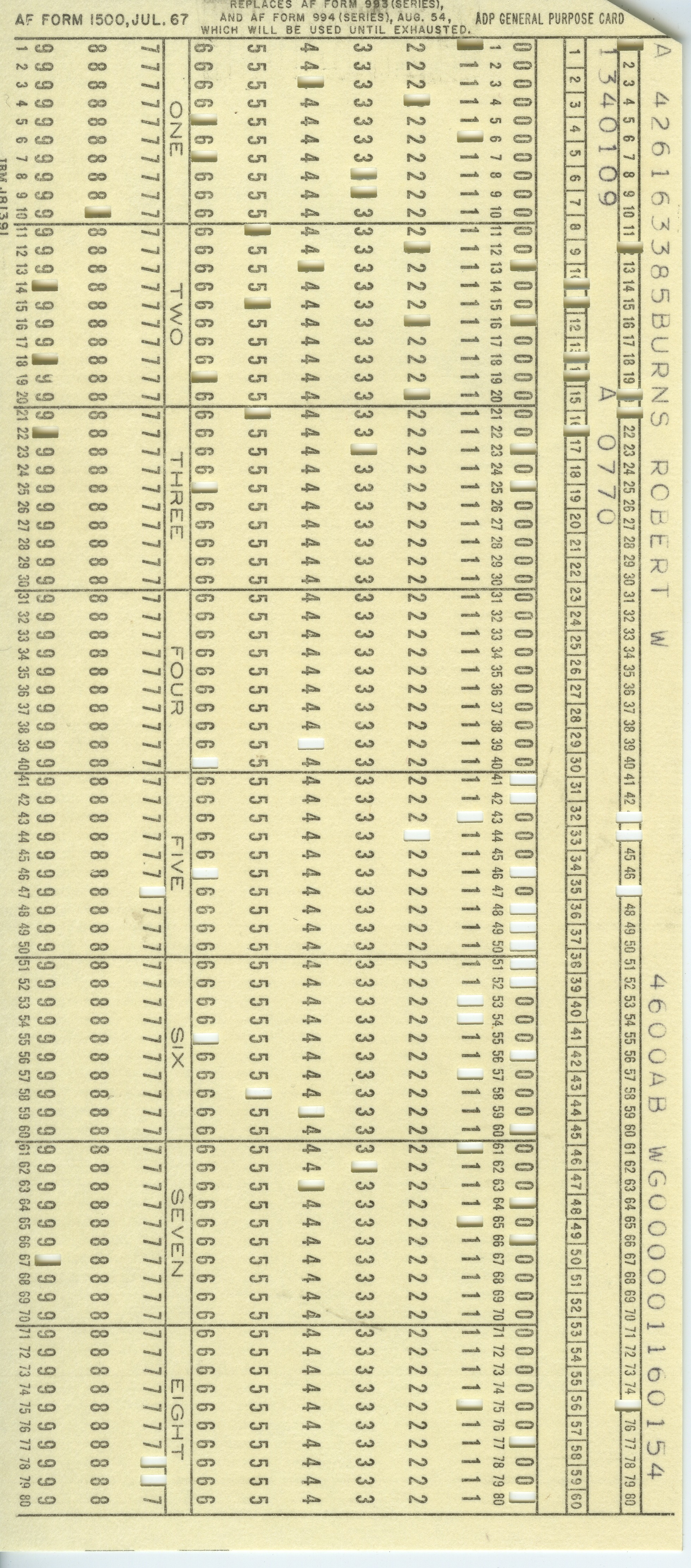
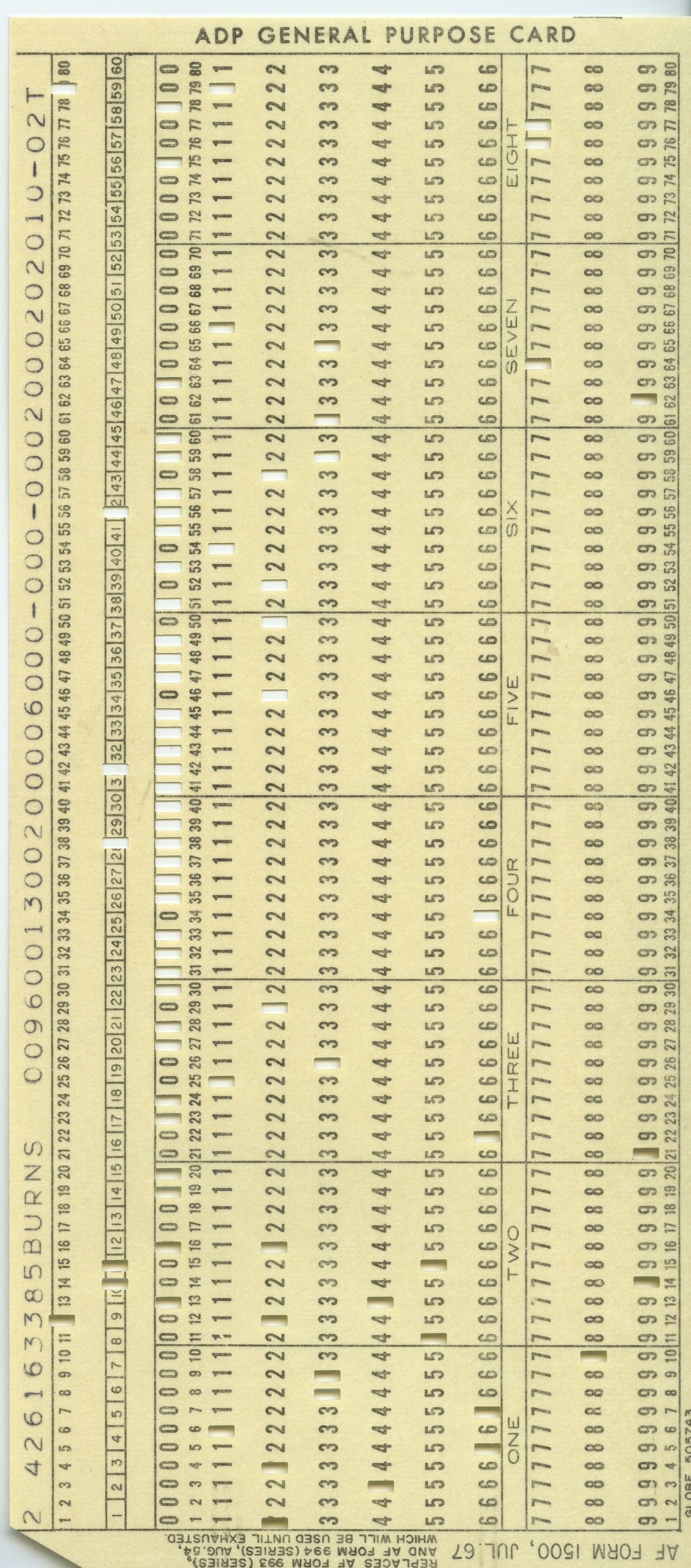
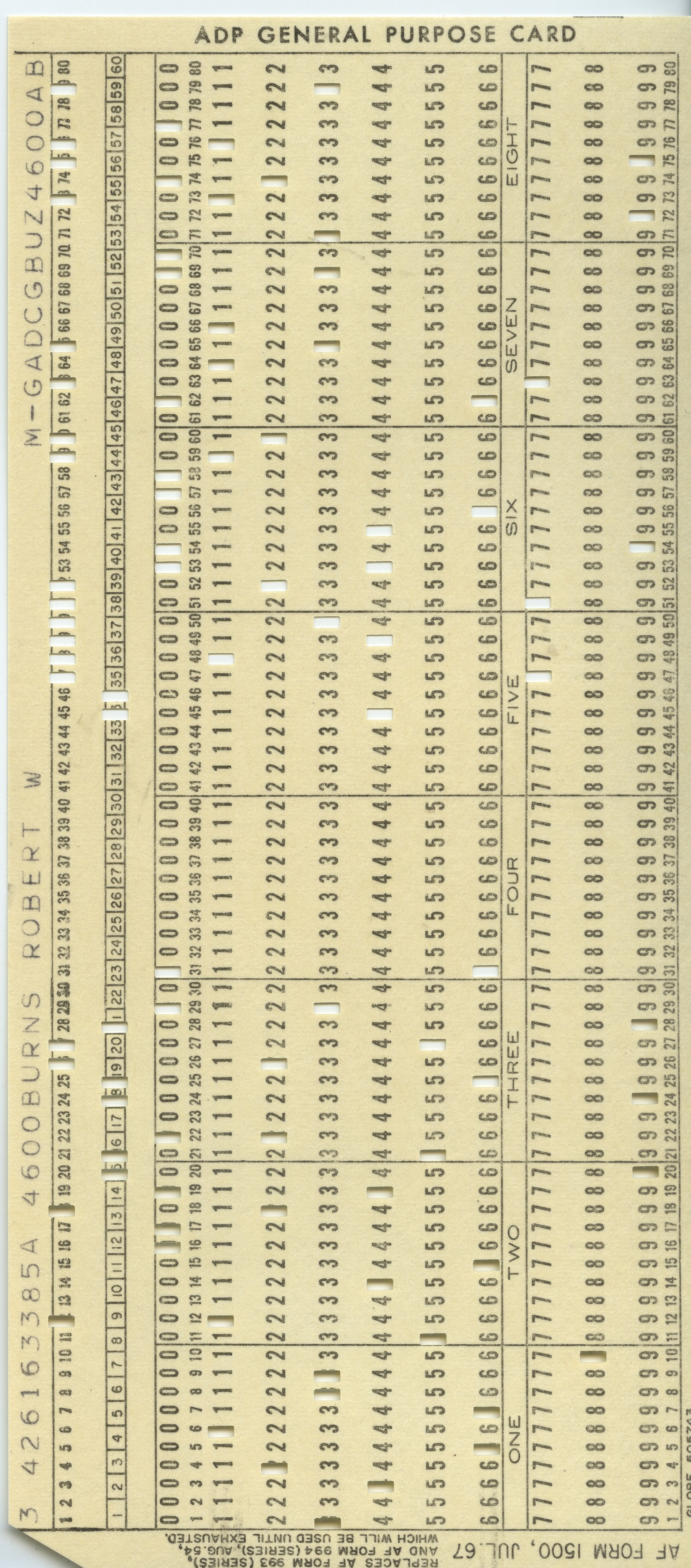
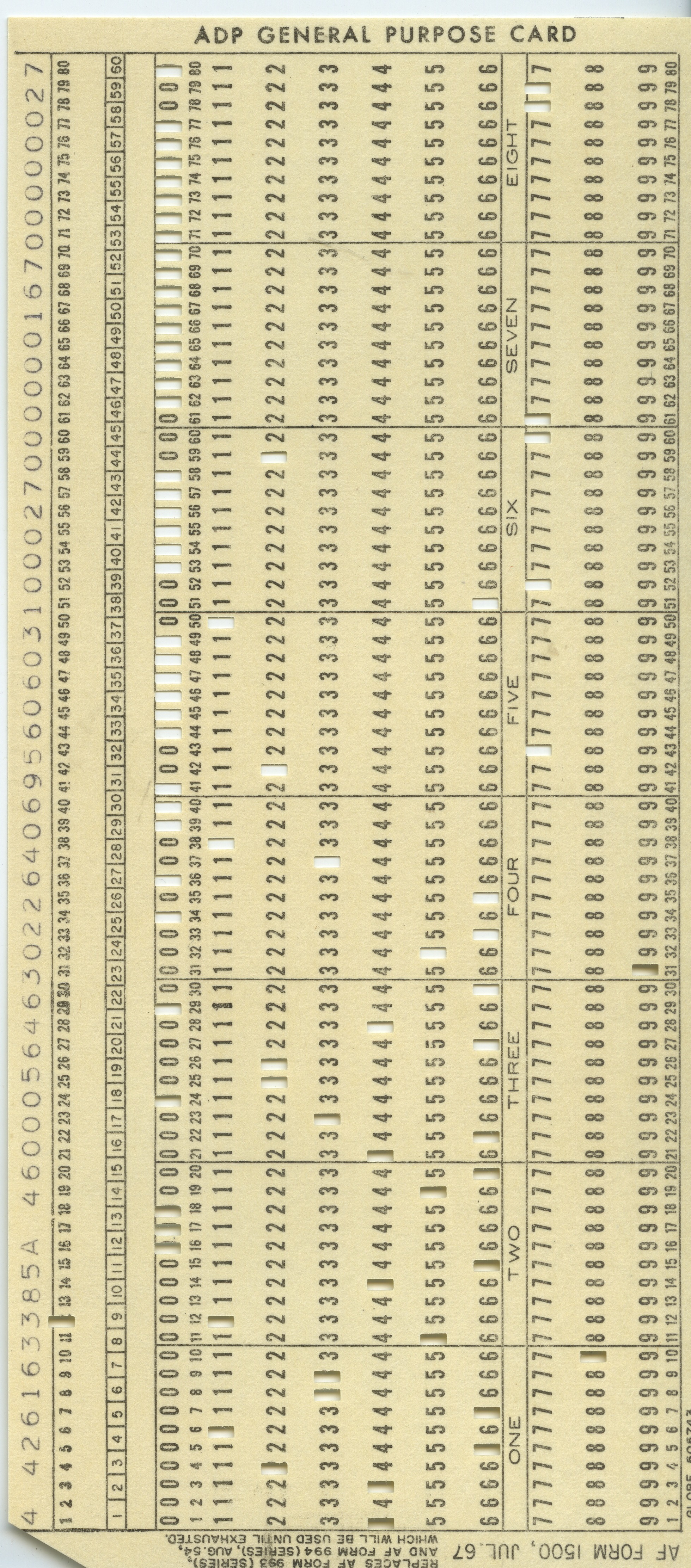
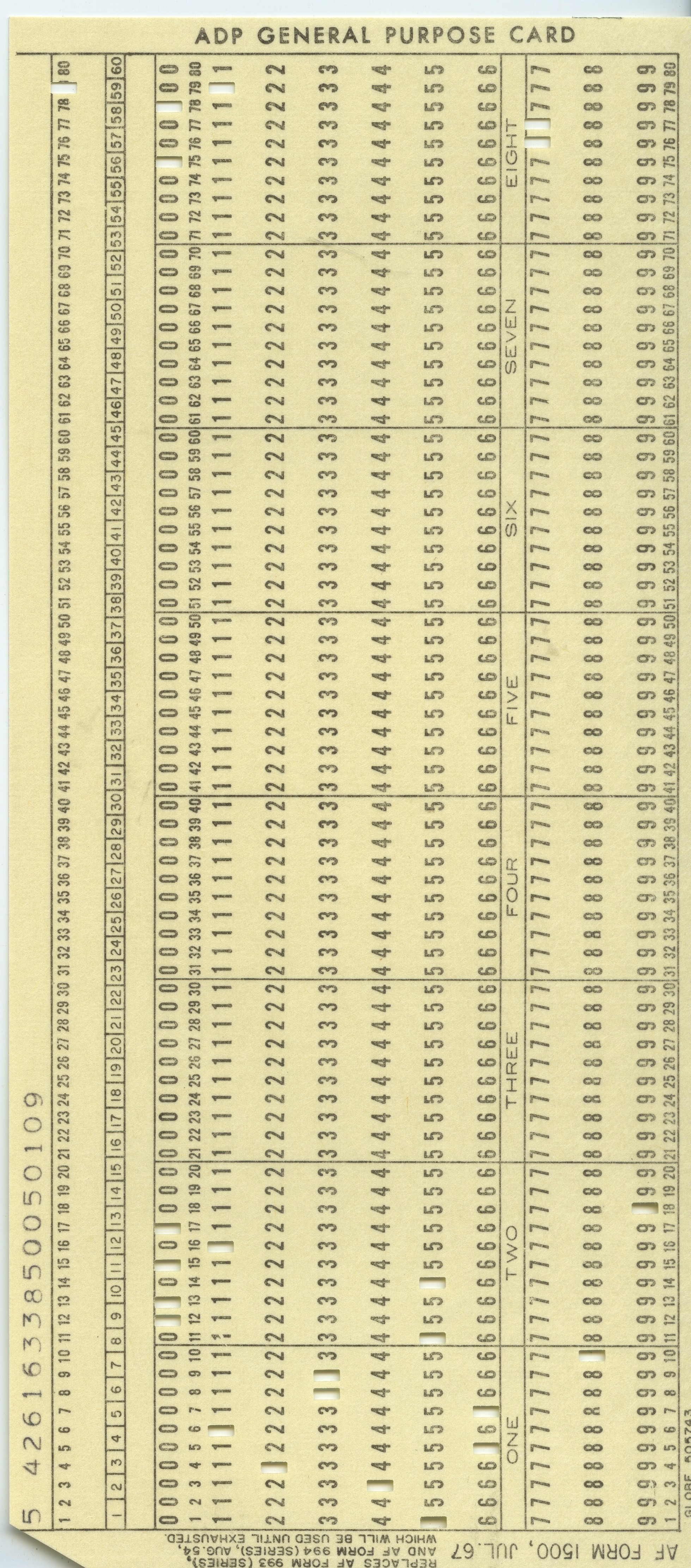
| Field | Value | Confidence |
|---|---|---|
| Card Type | A | High — Identification Card |
| Social Security Number | 426-16-XXXX | Very High — confirmed across cards |
| Last Name | BURNS | Very High |
| First Name | ROBERT | Very High |
| Middle Initial | W | Very High |
| Organization | 4600AB | Very High — 4600th Air Base Wing, Peterson Field, CO (flying operations) |
| Personnel Accounting Symbol | WG000001160154 | High |
| Columns | Raw Value | Probable Meaning | Confidence |
|---|---|---|---|
| 21–24 | 6302 | Total career flying hours, ~1968 | Medium-High |
| 37–40 | 3100 | Pre-ADP carry-forward (hours through ~1947–48) | Medium-High |
| 25–28 | 2640 | First-pilot hours (sub-category) | Medium |
| 41–44 | 0270 | Night or instrument hours | Medium |
| 49–52 | 0167 | Combat or instrument sub-category | Medium |
| 57–60 | 0027 | Link trainer / simulator | Medium |
This is what makes the punch cards archivally significant: we can compare the Air Force's machine-computed totals against the hours we've digitized from Bob's individual flight records.
The ~200-hour gap between our database (3,152) and the carry-forward figure (~3,100) is within the margin expected from ADP rounding and the fact that our database reflects a few gaps where forms are missing from the surviving records (some sheets absent from the source scans). These figures are broadly consistent and mutually validating.
The career total of approximately 6,302 hours implies Bob logged roughly 3,150 additional hours between 1947 and 1968 — about 150 hours per year on average across 21 years of Cold War service. This is entirely consistent with a career officer in an active operations squadron, cycling through staff tours with enough flying billets to maintain currency and accumulate meaningful time.
The 1967–1970 portion of his flight records (beyond the ADP card date) remains to be digitized, and will eventually let us close the gap between ~6,302 and his final career total at retirement.
Card 3 contains a coded string in columns 35–44. When we sent the punch card findings to family, Bob's son offered the most plausible interpretation to date:
| Segment | Probable Meaning | Confidence |
|---|---|---|
| M-G | Major General — Bob's rank as of ~1968 | High |
| ADC | Air Defense Command — the MAJCOM Bob was assigned to | High — confirmed by assignment records |
| G | General staff designation (headquarters billet) | Medium |
| BU | First two letters of Burns (name identifier) | Medium |
| Z | Administrative flying — currency flights rather than operational sorties | Medium (speculative) |
This interpretation fits what we know: by ~1968 Bob held the rank of Major General and was assigned to HQ ADC as Chief of Staff — a headquarters billet, not an active flying squadron. The Z suffix may flag that his flying was administrative currency (maintaining pilot proficiency in aircraft like the T-39 or C-131) rather than operational mission flying. The 4600th Air Base Wing at Peterson Field, CO was the unit of record for tracking that flying — exactly what the 4600AB suffix on his card represents.
Decoding this string definitively would require the original Technical Order or AFM defining the AF Form 1500 card layout — documentation that has not yet been located. If you have knowledge of USAF ADP codes from this period, we'd welcome any additional insight.
Two things converged to turn a thirty-year logbook into a deck of punched cards in 1968 — one that changed across the whole Air Force, and one specific to where Bob was standing.
The service-wide change. In July 1967 the Air Force introduced the AF Form 1500 ADP flight-records system, moving the tracking of every rated officer's career flying hours off hand-posted paper and onto machine-readable cards fed to mainframe computers. Currency, career totals, hours by category — all of it could now be computed and consolidated centrally instead of tallied by hand on the Form 5. Bob's cards are an early product of that system, filed by the Consolidated Flight Records Section the year after it began.
Where he was standing. By 1968 Bob was a major general at Ent Air Force Base in Colorado Springs — the headquarters of Air Defense Command and NORAD, and at that moment one of the most computer-saturated commands in the American military. Through the decade NORAD had built SAGE (the Semi-Automatic Ground Environment), a continent-spanning network whose direction centers ran on room-filling IBM computers to track every aircraft over North America; in 1966 it had finished a hardened combat operations center buried inside Cheyenne Mountain, a few miles from Bob's desk. Data processing wasn't a novelty at this command — it was the daily business of it. The same machine age that put a computer under a mountain to watch for Soviet bombers also reduced a general's flying career to five cards in an envelope.
There is a quiet symmetry in that. The young officer who learned to navigate by stopwatch and dead reckoning in a Canal Zone B-18 finished his flying in a command run by computers — and it was the computers that kept his hours.
The cards were originally scanned in early 2026 at approximately 150 DPI as part of a broader scan of Bob's flight record file. At that resolution, individual punch holes were visible but not reliably decodable.
In March 2026, the cards were rescanned at 600 DPI using a dedicated flatbed scanner, producing five TIF files at roughly 200 MB each. At this resolution, both the Hollerith punch holes and the keypunch-printed human-readable characters at the top of each card are clearly distinguishable.
The cards were then decoded using Claude Opus 4.6 (Anthropic's AI), which read each card image column by column — identifying characters from the printed top row and cross-checking against the visible punch patterns. The Hollerith encoding for alphabetic characters (e.g., B = zone-12 + row-2, U = zone-0 + row-4) was verified against the standard IBM Hollerith table and confirmed to match the printed interpretation on every tested column.
The full column-by-column decode is preserved in data/supplemental/punch_cards_decoded.md in the archive repository.