The Requirement
Bob arrived at France Field on December 26, 1939, assigned to the 7th Reconnaissance Squadron. His squadron commander was Captain Guy F. Hicks — a regular Army officer with over twenty years of service, described by Bob as "a character, of which there were a few in the Air Corps."
"At this time, all Air Corps pilots were also required to be qualified navigators and bombardiers because these specialties had never been deemed essential."
The B-18 the squadron flew was a military derivative of the Douglas DC-2 airliner — a twin-engine aircraft with a lengthened nose to accommodate a bombardier station. It was the standard heavy patrol aircraft of the Canal Zone before B-17s began arriving in 1941.
The Course
"I flew as navigator on a training mission with my squadron commander as the pilot. I have forgotten to tell you that my squadron was the 7th recon. equipped with B-18s, a converted DC-3. The course to be flown was a triangle with the navigator determining the turning points purely by time and distance allowing for the wind to be as briefed."
Time-and-distance navigation — dead reckoning — requires the navigator to calculate each heading and elapsed time using only the aircraft's airspeed, the briefed winds, and a watch. There are no external references: no radio beacons over the jungle, no landmarks to check against. The navigator commits to a heading, starts timing, and trusts the arithmetic.
The Moment
"The last leg was a return to base and as the time to arrive neared, the pilot looked at me a few times as if to say we were there but I determined to declare arrival when my watch came to the minute. When it did, I signaled that we were there."
The Payoff
"This made me the fair haired boy with the commander and my non-flying job was to be the squadron adjutant, a sort of aide to the commander and responsible for the morning report of status of personnel."
The squadron adjutant managed the administrative life of the unit — personnel status, orders, correspondence with higher headquarters. It was a position of trust given to junior officers the commander wanted close. The "morning report" Bob became responsible for gave this entire collection of his later family emails their name.
From the Flight Records
From the records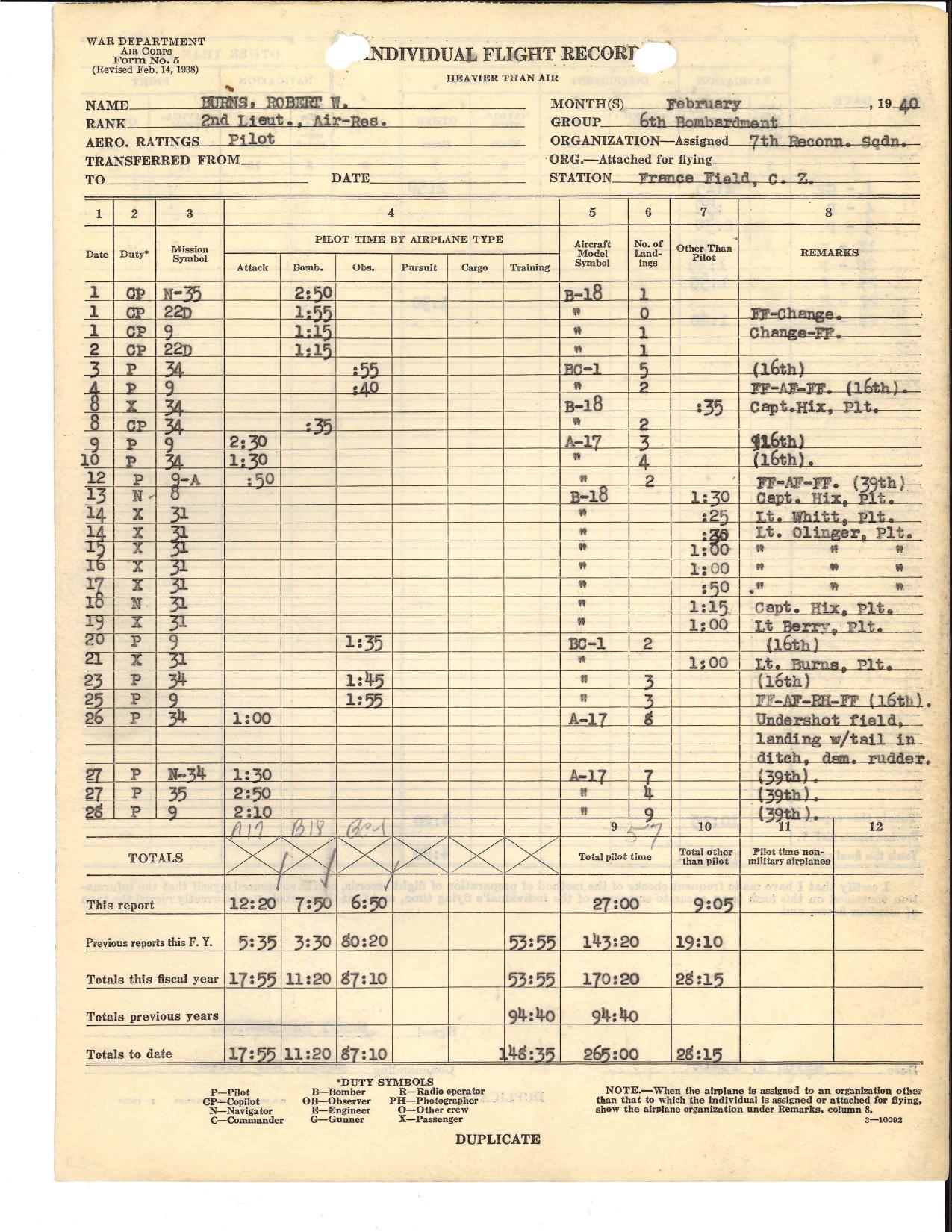
February 1940 — Individual Flight Record (Form 5), France Field, Canal Zone. Three entries in February show Bob flying passenger with Capt. Hix piloting: Feb 4 (35 min), Feb 13 (90 min), and Feb 18 (75 min).
All three entries show Bob logging passenger time — the Form 5 column for a crew member who is neither pilot nor copilot, consistent with the navigator role. Feb 4 at 35 minutes is too short for a triangular cross-country. Feb 13 at 90 minutes is the strongest candidate: long enough for a proper time-and-distance triangle over the Canal Zone, and the absence of a route abbreviation (unlike most entries, which note "FF-AF" or "FF-RH-FF") is consistent with a flight that never departed to a named waypoint — turning points determined by the navigator's watch alone. Feb 18 at 75 minutes is also plausible. Bob arrived at France Field on December 26, 1939; a navigation qualification flight in early February fits the timeline of a new officer settling into his first assignment.
View Canal Zone flight records →