Historical Context
RAF Polebrook (AAF Station 110, APO 634) sits in Northamptonshire, England, roughly 80 miles north of London. From April 1943 through the end of the war in Europe, it was home to the 351st Bombardment Group (Heavy), part of the 1st Air Division, 8th Army Air Force — “The Mighty Eighth.” The 351st’s distinctive aircraft marking was the triangle-J insignia on the tail of every B-17.
Bob arrived at Polebrook on the group’s first deployment. Over the following two years he flew as crew, then as air executive and deputy group commander under Col. William A. Hatcher Jr. and Col. Eugene A. Romig. On October 12, 1944, Romig moved up to command the 94th Bomb Wing and Bob assumed command of the 351st BG, serving until March 30, 1945 — just weeks before VE Day.
| Formation | November 1942, Geiger Field, Washington | |
| 8th Army Air Force | HQ High Wycombe, UK | |
| ↳ 1st Air Division | HQ Brampton Grange, Cambridgeshire | |
| ↳↳ 94th Bomb Wing | HQ RAF Polebrook | Brig. Gen. Julius K. Lacey |
| ↳↳↳ 351st BG (H) | RAF Polebrook | Col. Robert W. Burns (Oct 1944–Mar 1945) |
| Bomb Squadrons | 508th, 509th, 510th, 511th | |
By war’s end the 351st had flown 311 combat missions, dropped 20,778 tons of bombs, and destroyed 303 enemy aircraft. It had also suffered grievous losses — the cost of strategic daylight bombing against defended targets deep in Europe.
In Bob’s Own Words
Asked in 1979 about the high point of his career:
“Certainly nothing will ever compare with the 2 years with the Eighth Air Force fighting the war. That has to be a salient feature, not one that I ever care to repeat, of course, but recollections of that time I’ll never forget.”
Elsewhere in the same interview, on an episode that became his primary illustration of military integrity — when HQ 8th Air Force ordered formal aircraft recognition training time for all units:
“We were at war. We were flying around the clock. My solution: tack silhouette sheets in every latrine on the base, calculate average bathroom time per man per day, multiply by personnel count, and report that total as aircraft recognition training time.”
He acknowledged this was “fraudulent to some degree” but argued it protected his people from a useless maneuver — and used it as a case study in when and whether a commander acts as “God” by overriding a superior’s directive.
Clark Gable at Polebrook
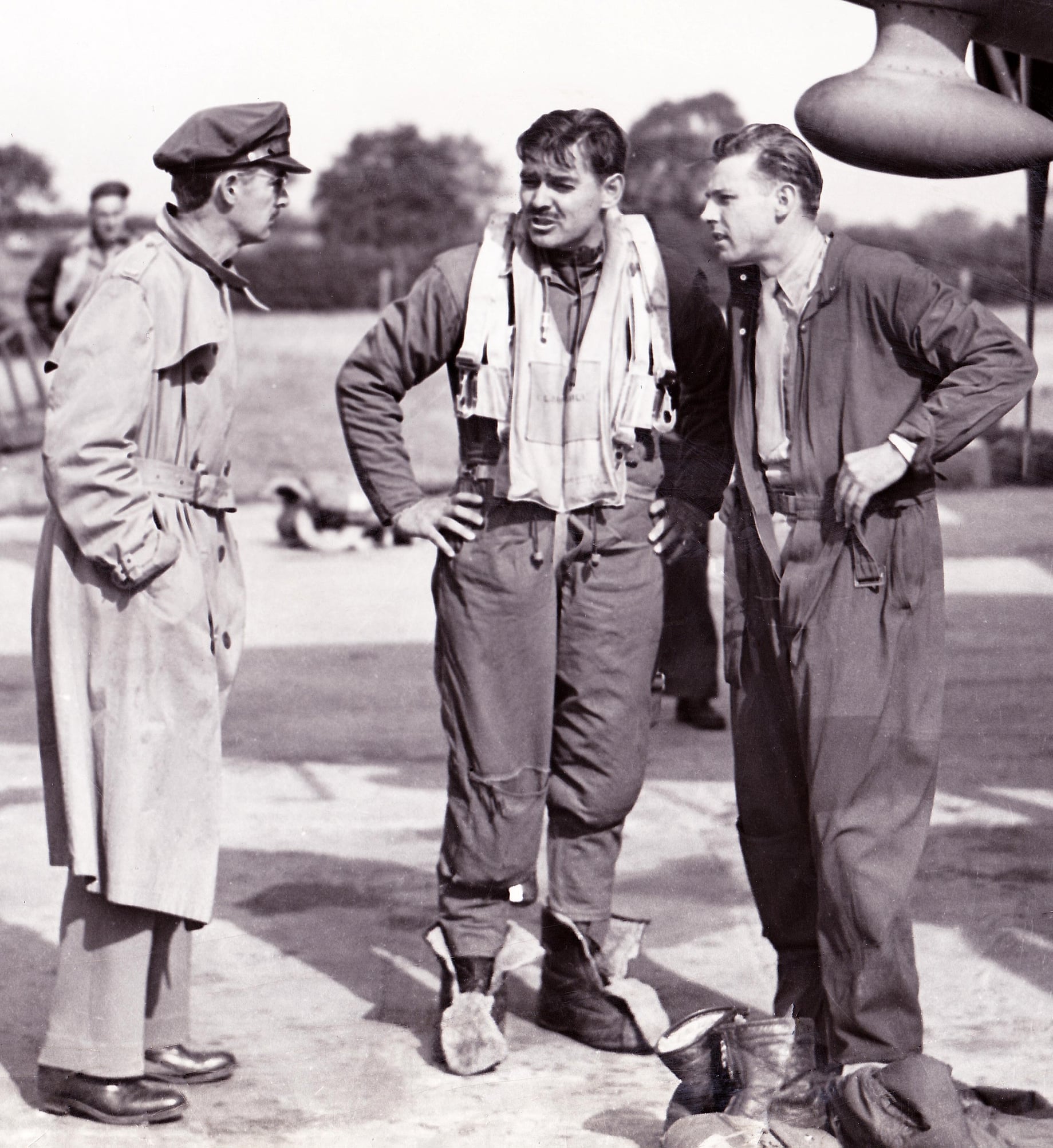
Hollywood legend Clark Gable — then 42 years old, a year after the death of his wife Carole Lombard — came to Polebrook in 1943 as a Captain assigned to the 508th Bomb Squadron under Lt. Col. James T. Stewart. His mission: film aerial gunnery footage for the USAAF training documentary that would become Combat America (1945).
Gable flew five combat missions with the 351st BG, including the September 23, 1943 Nantes raid that earned Bob his Silver Star. Bob describes the moment in his own account of the Nantes mission:
“Clark Gable was along with me and this was his last mission to fly. When we got down into the sea haze, both Gable and I went to the nose and each of us handled a gun, looking for any stray fighter who might find us. I did it because I had never had a shot at a fighter and I looked forward to it. After about 20 minutes, out of the murk came about twenty or so fighters in formation headed directly at us. The closing speed was so great that neither I nor Gable had time to fire a shot, and the fighter force was in the same boat.”
The Combat America documentary Gable produced from this footage is a primary record of life at RAF Polebrook during the war. It is in the public domain and is presented on its own page in this archive.
Photographs
Flying School & Early Career
4 photosPolebrook, 1943–1945
16 photosMorning Reports
First-person stories from Bob’s wartime service, drawn from oral history, letters, and family memory. Stories are ordered roughly chronologically.