A Night Away from the War
Through 1943 and 1944, Ruth Josephine Blackburn — Army nurse, 160th Station Hospital — was stationed in England while Bob flew combat missions from Polebrook, sixty miles north of London. They had met on bicycles near Lilford Hall in mid-1943, and the relationship had deepened through Bob's regular flights down to wherever Ruth's hospital was stationed. After the hospital moved to Bath, Bob had convenient access to the airfield there — "I could come to call in any plane I chose," as he put it.
London was the natural meeting point. Bob could fly or take the train; Ruth could arrange leave. In 1944, the city was still very much at war — flying bombs had begun falling on London in June — but it was also the cultural capital of the Allied effort, and the great institutions of British and American wartime entertainment were operating.
This Is the Army
"After Ruth's hospital had moved to Bath, Irvin Berlin staged a show in a London theater featuring all his music pertaining to the Army. I got tickets and Ruth came over to London. We saw the show, which was my first Broadway production. Then we went to Maxim's Chinese restaurant for a fine meal."
Irving Berlin's This Is the Army was a revue built around Berlin's military songs from two wars — including "Oh, How I Hate to Get Up in the Morning," which he had written during World War I and performed again himself, in his old Army uniform, for World War II audiences. The show opened on Broadway in July 1942, ran for over 300 performances, and then toured the United States before going overseas. It ran in London in 1943–1944 to enormous audiences of Allied servicemen and women.
For Bob, a boy from rural Mississippi who had spent nearly his entire adult life on military bases, it was the first Broadway-style theatrical production he had ever seen. He got tickets and brought Ruth.
Irving Berlin (1888–1989) composed This Is the Army as an all-soldier revue, donating all profits to the Army Emergency Relief Fund. The show included "I Left My Heart at the Stage Door Canteen" and "This Is the Army, Mr. Jones." Berlin personally performed "Oh, How I Hate to Get Up in the Morning" at every performance — the same song he had written as a draftee in 1918. He was 54 years old when the show opened.
Maxim's Chinese Restaurant
After the show, they went to Maxim's Chinese restaurant — a London establishment that had survived the Blitz and continued to serve through the wartime years as a landmark of relative civilian normality in a city that had been through a great deal.
It was the kind of evening that sustained people through the weight of what surrounded it: a group commander flying against some of the most heavily defended targets in Europe, and an Army nurse working in a military hospital. An evening of music, a fine meal, and each other's company.
Bob and Ruth married in Greenwich, Connecticut, in 1946, after the war (the couple were then stationed at Mitchel Field, New York). But the story that preceded it was assembled from evenings like this one — a theater in London, a Chinese restaurant, and a war that both of them were determined to survive.
From the Flight Records
From the records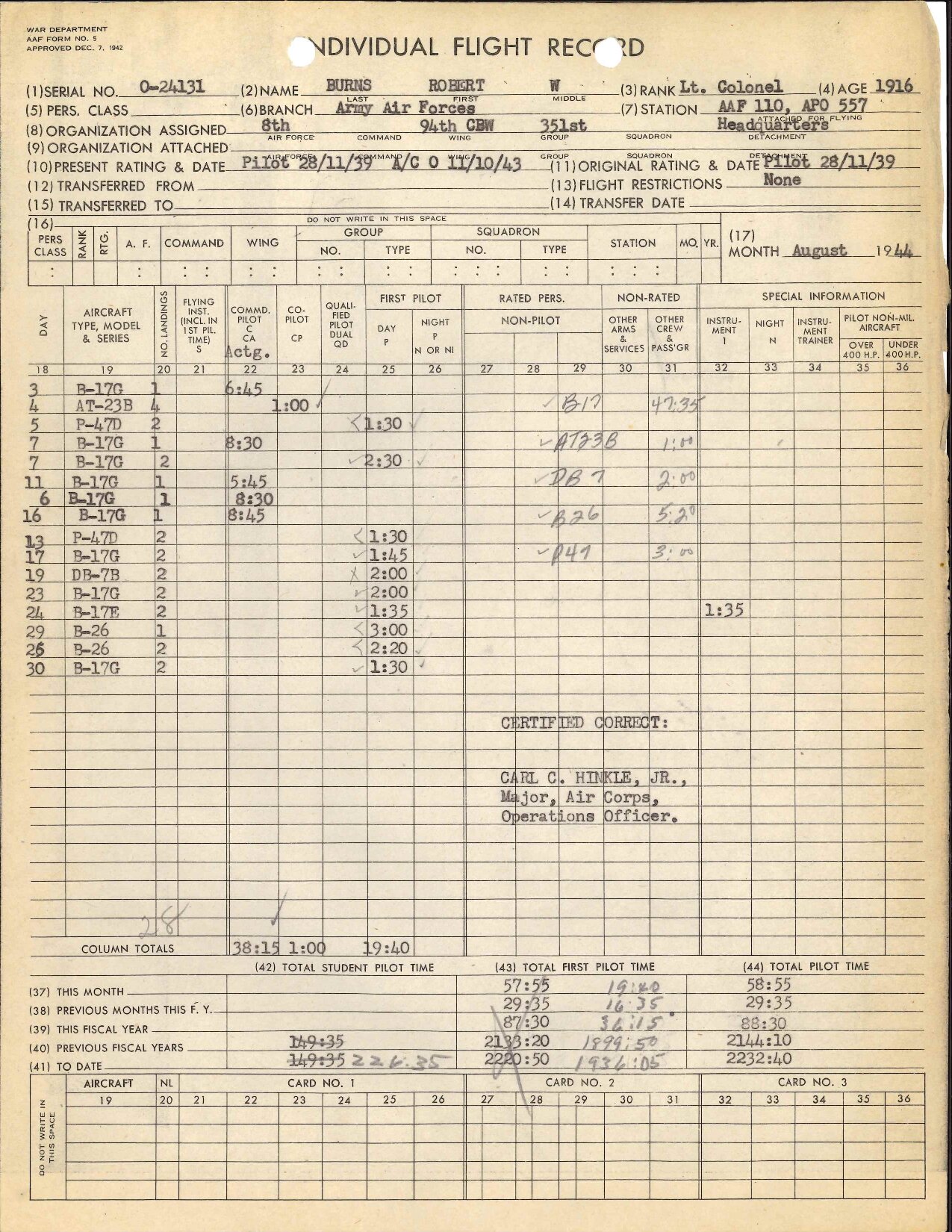
1944 Form 5 — the combat rhythm the London evenings were stolen from.
A night at a West End show with Ruth left no trace in a flight record. The forms of these months document what made such evenings rare: the operational tempo of a group at war, sixty miles north of the city.
View all flight records →