Arriving at Polebrook
The 351st Bomb Group flew its air echelon to England in the spring of 1943, arriving at RAF Polebrook in Northamptonshire. Polebrook was an existing RAF station, and the British kept support staff in place until the American ground echelon — which had come by sea — arrived some two weeks later.
"The overseas movement of our group was divided into the air and ground echelons. The air bit consisted of the combat crews and Hqs. staff associated with flying. All the rest came by sea transport and arrived at Polebrook some two weeks after we did. Polebrook, being an RAF station had a fair amount of support people in place who stayed until our ground people arrived. They operated the various mess halls on the base. The staff officer's mess, where I ate, introduced me to Brussel sprouts and I don't like them yet."
There was a formal ceremony for the transfer of the base from British to American command — "the Duke of somewhere" representing the UK, Hatcher accepting for the US. Then training began in earnest.
A Tragic Practice Accident
The 351st had barely two weeks to familiarize itself with the airspace over England before it was ordered to fly combat. In those two weeks, the group suffered its first loss.
"At the end of the 2nd week at Polebrook, we had a tragic accident. During a practice mission, a squadron commander, flying on the left wing of a flight hit the tail section of the lead airplane and went straight in, killing the crew. The lead plane with no tail, also went in. The tail section with the gunner inside, fluttered to the ground and the gunner survived the wreck. A very sad affair."
The group lost two aircraft and most of their crews in a training accident before flying a single combat sortie. It was the kind of loss that the Air Corps tried not to publicize — not combat, not enemy action, just the lethal arithmetic of operating large formations of complex aircraft flown by crews still developing their proficiency.
Hatcher's Aborted First Mission
The notification came: the 351st would fly its first combat mission the following day. Colonel Hatcher would lead.
"After two weeks, we were notified that we would fly our first combat mission the next day. The ground crew not yet in place, I oversaw the loading of the aircraft with bombs, ammunition, and oxygen. This activity lasted most of the night. Col. Hatcher led this mission, which was aborted when the assembly of the group was too late to join the formation. And Hatcher announced that we wouldn't do that again, and we didn't."
The abort was operationally embarrassing but not uncommon for a group flying its first mission. The Eighth Air Force flew in large, carefully sequenced formations; a late-assembling group was a liability. Hatcher's declaration — that it would not happen again — was the kind of unambiguous expectation that had defined his leadership since Geiger Field.
Bob's Turn
The next day, the 351st was briefed for another mission. It was Bob's turn to lead.
"That afternoon and night, I again rode herd on the preparations, attended the briefing, watched the return and heard the debriefing. Things went well for being our first effort. We were also alerted for a mission the next day and it was my turn to lead."
"I guess I slept a bit and the briefing, takeoff and assembly, and join-up with the bomber stream went well. The target was Emden on the German coast. There was a little flak, and I recall my indignation when fighters kept making passes at us, even after we were back over the water. I suppose that I felt that they had had a fair shot at us and ought to have left us alone after we had left their territory. But it didn't take me long to learn that an enemy is an enemy and deserves killing whenever and wherever you find him."
Emden, on the northwest coast of Germany at the mouth of the Ems River, was a relatively accessible target — short penetration of German air defenses, moderate fighter opposition. It was standard for new groups to be assigned shorter-range targets on their first missions while they developed their proficiency. The 351st had gotten there and back, with a little flak and some fighters, but no losses. It was a beginning.
Aftermath: Sleep
"After debriefing, I went to my quarters and joined Gable and some of his folks who lived in adjacent quarters, for a rehash of the mission. The sun was warm and I don't recall going to sleep in my chair, but I woke, hours later in my bed. Exhaustion had done me in."
Clark Gable was quartered near Bob at Polebrook, part of a small film unit Gable had brought along to document the air war. The sun, the debrief, the physical and emotional weight of leading his first combat mission — Bob was asleep before he knew it, transferred to his bed at some point by someone he didn't remember.
The 351st's Combat Record — The group went on to fly 311 combat missions from Polebrook between May 1943 and April 1945, completing 8,000+ sorties and earning two Distinguished Unit Citations. Bob commanded the group through much of 1943–1944, leading missions to some of the Eighth Air Force's most heavily defended targets in Germany and occupied Europe.
From the Flight Records
From the records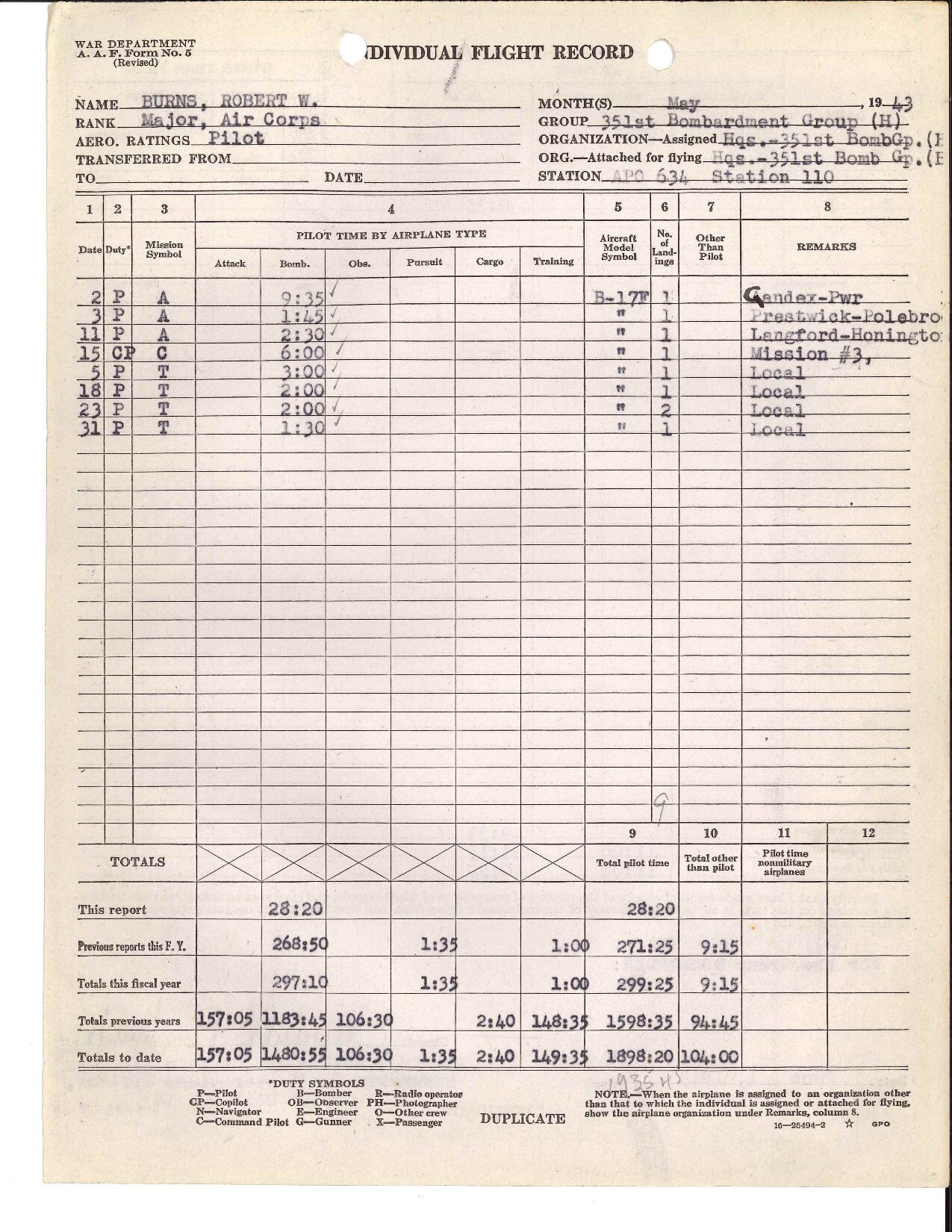
May 1943 — Bob’s first Form 5 at Polebrook. The Emden mission is the 6:00 entry on May 15, noted “Mission #3.”
Bob’s first numbered combat entry is the 351st’s third group mission — flown May 15, 1943, the day VIII Bomber Command struck Emden. Six hours over the North Sea, exactly as the story tells it.
View all flight records →