The Failure
The 351st Bomb Group was moving east toward England, making stops at Kearney (Nebraska), Presque Isle (Maine), Gander Lake (Newfoundland), then across the Atlantic. Bob was flying one of the group's B-17s to Maine when a propeller governor failed over Detroit.
"On my flight to Maine I had a propeller governor fail, which I knew would require an engine change."
A failed propeller governor means the prop can't be controlled—it will overspeed and potentially destroy itself. The solution: land, get a new engine. Simple enough.
But here's where Bob made what he later called "a stupid mistake."
The Mistake
"And here I made a stupid mistake. The failure occurred just about right over Selfridge Field, at Detroit, and I immediately landed there. I soon found out that there was no spare engine there and it would take a week or more to get one."
The smart move would have been to divert immediately to Wright-Patterson Air Force Base—the major depot with plenty of spare engines, equipment, and personnel to make the change quickly.
"Then I realized that when the failure occurred, I should have gone directly to the depot at Wright-Patterson, where there were plenty of engines, and people and equipment to make the change."
But Bob was at Selfridge. No spare engine. A week's delay. And he'd heard a rumor.
The Rumor
The rumor: A B-17 could take off on three engines.
Bob decided to test that rumor. With a full fuel load—configured for an Atlantic crossing—and a full crew.
"But having heard a rumor to the effect that a B-17 could take off on three engines, I decided to give it a go. I thought that we would start the take off roll with all four engines and only feather the bad one when the prop overspeeded."
His plan: accelerate with all four engines running, then feather (shut down) the bad engine when the propeller started to run away. He guessed that would happen around 60 mph.
The Takeoff
The plan fell apart immediately.
"I guessed this speed to be close to 60 mph so, with all hands and a full fuel load, we started the takeoff. The prop began to run away at about 25 mph..."
25 mph. Not 60. The propeller was overspeeding before they had any meaningful airspeed. But the runway had no obstructions until it reached a lake at the far end. Bob kept going.
The situation:
• Full fuel load (Atlantic crossing weight)
• Full crew aboard
• Three engines only
• 25 mph when engine failed (far too slow)
• Lake at end of runway approaching
The Lake
"...but since the runway had no obstructions until over a lake, I plowed on."
As Bob neared going into the lake, he eased the nose back slightly. There was "just a smidge of lift." Not enough to climb. Not enough to turn. Just enough to keep the aircraft barely above the water.
"As I neared going into the lake, I eased to nose back a trifle and there was just a smidge of lift. I nursed the plane for what seemed like an eternity until I could get enough airspeed to start a climb."
He nursed the B-17—full fuel load, three engines, barely flying—across the surface of the lake "for what seemed like an eternity." Gradually, painfully, the airspeed built. Finally, there was enough speed to start a climb.
The rest of the flight to Wright-Patterson was routine. The engine change took a couple of days.
The Reflection
Decades later, Bob reflected on the close call with characteristic honesty:
"But the closeness of the call there has remained to this day. Lots of stupidity there, that a little more thought would have eliminated the risks I had generated."
He could have diverted to Wright-Patterson immediately when the governor failed. He could have waited a week at Selfridge for a spare engine. He could have offloaded fuel to reduce weight before attempting the takeoff.
Instead, he tested a rumor with a full fuel load and a full crew, nearly putting a B-17 into a lake in Michigan.
The rumor was technically correct: a B-17 could take off on three engines. But barely. And "what seemed like an eternity" over a lake was a high price to pay for confirming it.
Years later, Bob's assessment:
"Lots of stupidity there, that a little more thought would have eliminated the risks I had generated."
From the Flight Records
From the records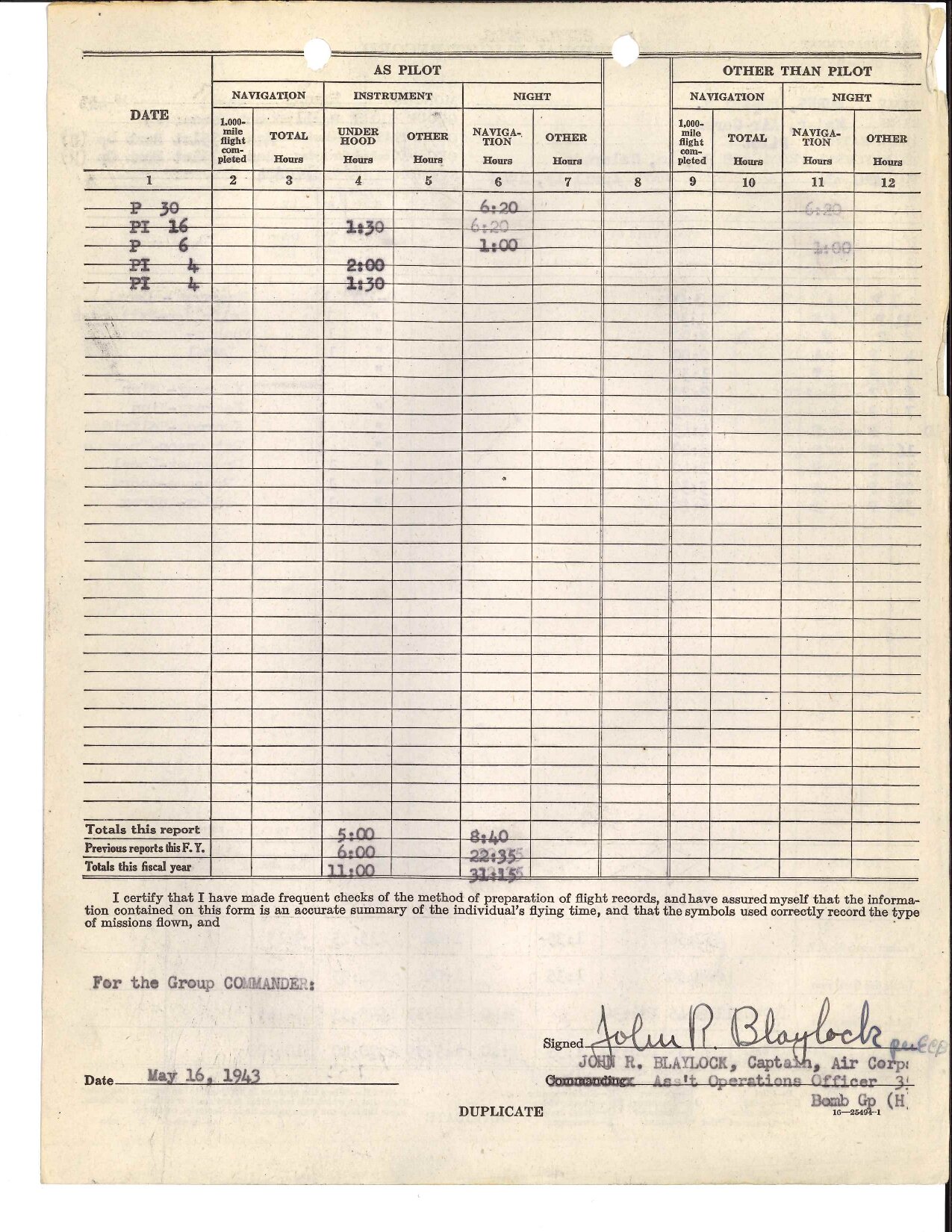
April 1943 — Individual Flight Record (Form 5). The Selfridge landing and the Selfridge–Patterson hop appear on lines 10 and 11.
The route is documented in Bob's Form 5 notes exactly as the story describes. April 10 is the flight from Kearney that ended at Selfridge — where the propeller governor failed. April 11 is the three-engine flight: 90 minutes from Selfridge to Wright-Patterson (only ~100 miles), the short hop that crossed the lake. April 16 shows the resumed journey to Presque Isle five days later, after the engine change at Patterson. The 5-day gap between the Selfridge landing and the Patterson departure reflects the time needed to arrange the repair.
View all flight records →