Backstory: The Statue of Liberty
Before Flight Officer Comfort became Bob Burns' copilot, he was a pilot himself. On the 351st Bomb Group's flight from Kearney, Nebraska to Presque Isle, Maine, his crew had buzzed the Statue of Liberty—a stunt that didn't amuse Col. Hatcher.
"I forgot to mention a very significant matter that occurred on the Group flight to P.I. One crew had flown a buzz job over the statue of Liberty on the way. Col. Hatcher knew about this and as punishment, he demoted the two pilots. He made my co-pilot the pilot and the old pilot the co-pilot. I got the old co-pilot, a flight officer named Comfort. I had never seen him before but I gave it no thought."
Flight Officer (F.O.) was a warrant officer grade the Air Corps used when pilot demand exceeded supply—often assigned to pilots without college time. Bob inherited F.O. Comfort as his copilot for the Atlantic crossing. He'd never met him before departure.
The First Crossing: Engine Failure
Bob's first attempt to cross the Atlantic from Gander Lake was aborted an hour into the flight when a supercharger failed.
"My departure for Prestwick had gone on for an hour when the flight plan called for a climb to 18,000 feet to take advantage of tail winds. I started the climb and discovered then that the supercharger on one engine had failed. Now what to do. I knew that I could get to the assigned altitude but it would require more fuel consumption on the good engines all the way. I decided to turn back to Gander Lake."
An engine change took about a day. Bob test-flew the aircraft, and they departed that night for Prestwick—8 hours over the North Atlantic. The plan: climb to cruise altitude, set the autopilot, and take turns at the controls with his copilot to manage fatigue.
"We climbed to our flight altitude and set course, 60 degrees magnetic. I then discovered that our auto-pilot was out of commission."
The Discovery
With no autopilot, hand-flying was mandatory. Bob told F.O. Comfort they'd alternate: one hour each, for the eight-hour flight. Bob took the first hour.
"So I turned to Mr. Comfort and told him that I would hand fly for an hour, then he for an hour, for the 8-hour flight."
After his hour, Bob leaned back in his seat, resting his head against the window where he could see the big magnetic compass at the top center of the windshield. The heading: 060°. The smooth air and drone of four engines lulled him off to sleep.
"I don't know for how long, but certainly not very long. When I came to, I looked at the compass and it read 120 degrees."
They were supposed to hit an island—not the continent of Europe. A 60-degree heading error would take them far off course. Bob called the navigator to verify the course. Still 060°. Then he asked Comfort what the hell he was doing flying 120°.
"He said he didn't know."
Bob corrected back to course and told Comfort to hold that heading. But five minutes later, the right wing began to drop. A slow turn to the right began again.
"I grabbed the wheel and jerked it back on course. Then I asked Comfort if he knew how to fly on instruments. His response was that he reckoned that he couldn't. That he had had no training for it."
An Atlantic crossing. At night. In a four-engine bomber. And the copilot couldn't fly on instruments.
Seven More Hours
Bob told Comfort to lie back in his seat and enjoy the ride to England. Then he hand-flew the rest of the trip—seven more hours through the night over the North Atlantic, with no autopilot and no relief pilot.
"So I told him to lie back in his seat and enjoy his ride to England. I flew the rest of the trip by hand and I was a tired soul when we landed at Prestwick."
One sight during that long night stayed with him: his first viewing of the aurora borealis—streams of light in the northern sky.
"One memorable sight that night was my first sighting of the aurora borealis. Streams of light in the northern sky."
Epilogue
After landing at Prestwick, the crews were briefed, fed breakfast, and sent to sleep in a dorm with coarse but delightful sheets. That afternoon, they flew in formation to their designated bases. Bob's B-17 dropped off third at Polebrook.
As for F.O. Comfort?
"Incidentally, Mr. Comfort got shot down on his first mission and spent the war in a stalag. I ran into him sometime afterwards here in the states and he was an emotionally broken man. I am sure that he was immediately retired or separated."
Bob never forgot the close call—not the danger of missing Iceland entirely and flying until fuel exhaustion over the open Atlantic, but the sheer exhaustion of hand-flying for eight hours through the night. It was a reminder that in the Air Corps of 1943, not every pilot was trained to the same standard—and sometimes, you had to fly the mission alone even when you weren't supposed to be.
From the Flight Records
From the records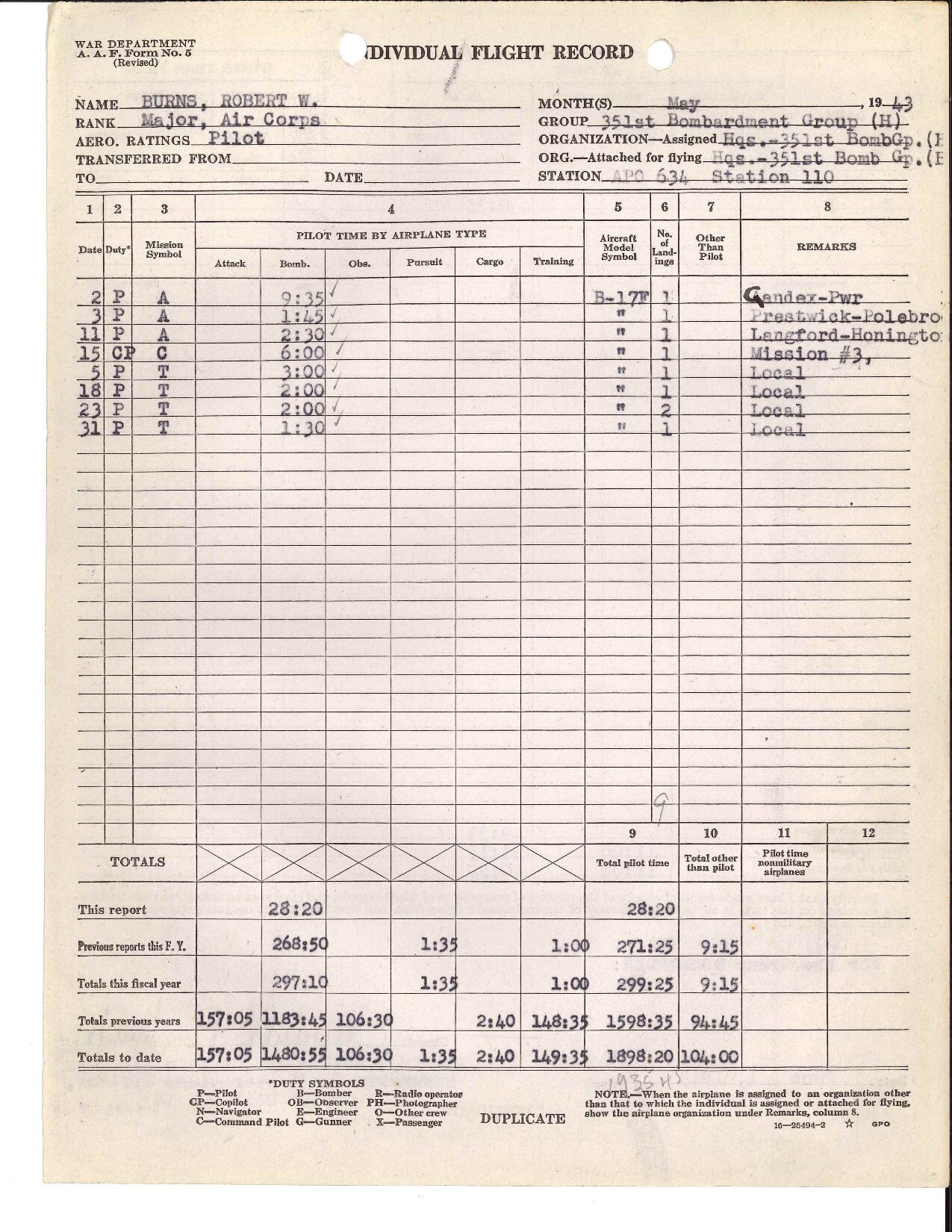
May 1943 Form 5. The Atlantic crossing is the first line of his European war: “Gander–Pwp” (Prestwick), May 2.
The crossing itself is on the form — May 2, 1943, Gander to Prestwick, matching the movement order of April 17 (Ops Orders No. 39, preserved in his 201 file, which lists F/O J.Z. Confort as co-pilot). The recorded duration is shorter than the ~11-hour crossing he describes; early forms often credited only part of a leg’s time, and the entry is flagged in the archive’s verification queue.
View all flight records →