The Colonel in Bath
By the spring of 1944, Bob had been in England for nearly a year and had been commanding the 351st Bomb Group since early 1944, when his predecessor was reassigned. Ruth's hospital — the 160th Station Hospital — had moved from the area near Polebrook down to Bath, in Somerset, a Georgian spa city far to the southwest. The airport at Bath gave Bob a convenient excuse to fly down regularly, in whatever airplane he chose: the group had a B-17 assigned to Headquarters, and by this point Bob also had a P-47.
On one of these visits, Bob came down with a serious cold.
"I had gone down to Bath and had a terrible cold. I must have had a crew drop me off. They put me in the hospital and I was there when D-Day occurred."
June 6, 1944
Operation Overlord — the Allied amphibious invasion of Normandy — began in the early hours of June 6, 1944. The Eighth Air Force flew nearly 3,000 sorties that day in support of the landings, dropping bombs on coastal defenses ahead of the assault. The commanding officer of the 351st Bomb Group was in a hospital bed in Bath.
"I called my deputy at Polebrook for an airplane to get me back to the base and I did my recovery there. I flew a mission or two during the invasion."
He got an airplane. He got back. He flew.
The matter-of-factness with which Bob recounts this is characteristic — the same tone he uses for the gas mask on New Year's Eve, or the three-engine takeoff over Lake Huron. Here is the most consequential day in the European war, and his personal narrative consists of a cold, a phone call, and two missions. The history was enormous; his part in it was just his job.
What Those Missions Were
The 351st Bomb Group flew several missions during the Normandy invasion period. On D-Day itself and in the days immediately following, Eighth Air Force heavy bombers struck German defenses, transportation chokepoints, and oil targets to prevent reinforcement of the beachhead. Bob's June 1944 flight records show multiple entries in the days around D-Day; the specific missions he refers to are in those forms.
The Eighth Air Force on D-Day flew 2,362 heavy bomber sorties on June 6, 1944 — the largest single-day operation in the Eighth's history to that point. The 351st Bomb Group participated. Bob's flight record for June 1944 documents his missions during the invasion period, though the specific entries cover the ground Bob was flying from Polebrook after his return from Bath.
What stays with the reader is the image: the group commander lying in a hospital bed when the invasion he had spent a year preparing for finally begins — and his immediate, instinctive response to call his deputy and get a plane back. Not because duty required it; no one would have faulted a sick commanding officer for staying in hospital on D-Day. Because that was simply where he needed to be.
From the Flight Records
From the records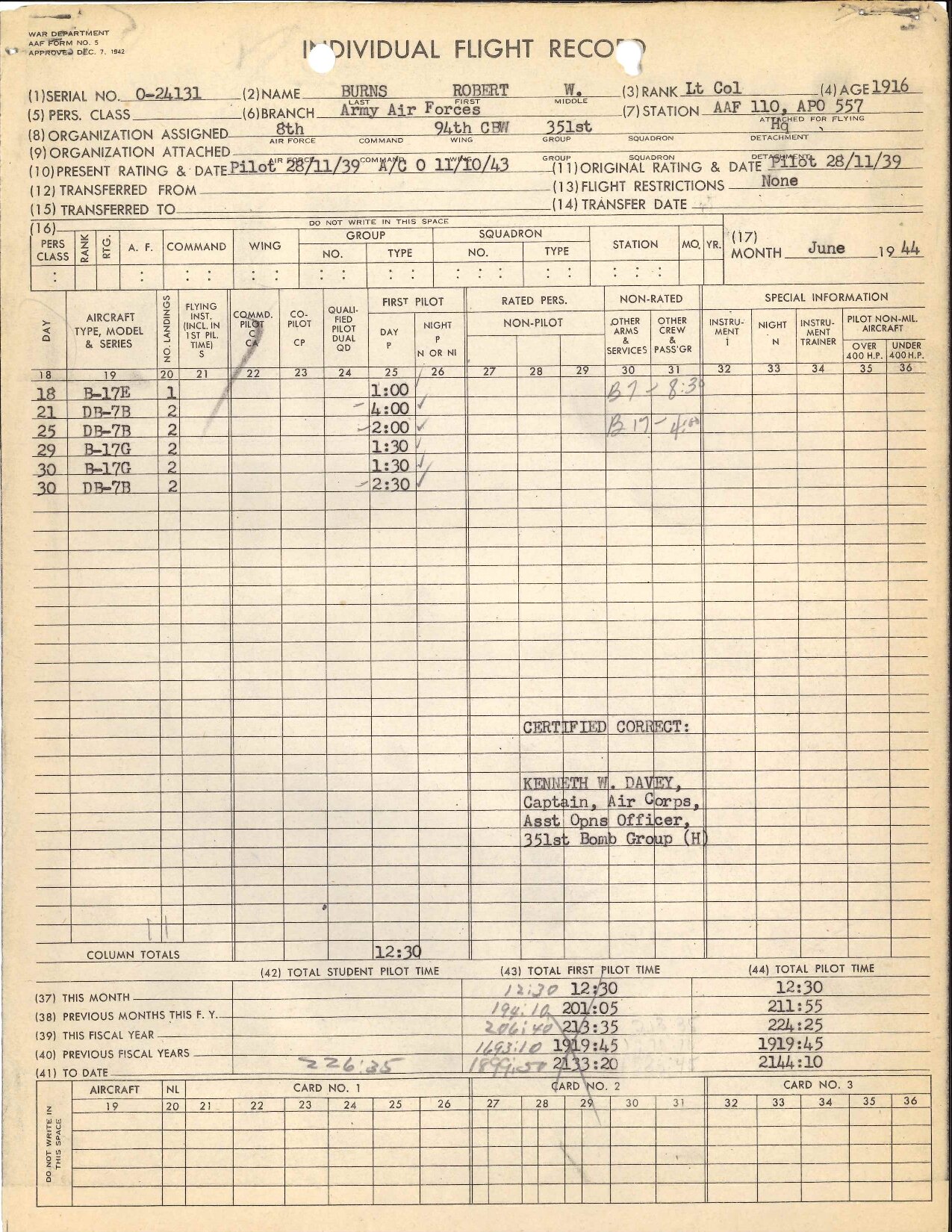
June 1944 Form 5 — the first entry of the month is June 18. The blank lines above it cover D-Day.
The record corroborates the story precisely: the commander of the 351st logged nothing for the first seventeen days of June 1944. He heard the invasion announced from a hospital bed, and was back on the schedule June 18.
View all flight records →