The Policy
Bob had a policy at Polebrook: when a crew aborted a mission, he would personally take the airplane up and determine if the abort was justified. This didn't happen very often—most aborts were legitimate mechanical issues that truly prevented the aircraft from continuing the mission.
"Sue asked me to recount the case of the pilot who aborted the mission too many times for no good reason. I had a policy at Polebrook, that, when a crew aborted, I would take the airplane up and determine if I thought the abort was justified. This didn't happen very often."
The Pilot
One crew stood out. The pilot was a graduate in aeronautical engineering and a senior captain—qualified and experienced enough to fly as either an element leader or squadron leader. These were critical positions in the combat box formation, responsible for leading other aircraft through the mission.
But this pilot aborted too many times, and Bob's test flights couldn't find legitimate mechanical reasons.
"But I had one crew whose pilot was a graduate in aeronautical engineering and a senior captain. As such, he was either an element or squadron leader. We had provisions for the filling of a vacancy if these slots were shot down or damaged, but this pilot aborted too many times for no legitimate reason that I could detect."
The Conversation
Bob called the pilot in for a talk. The message was simple: when you're entrusted to lead, you have responsibilities that must be performed. Leadership positions weren't just rank and prestige—they were critical to the mission and the safety of the other crews following you.
Bob's solution was elegant:
"So I called him in and explained that when one is entrusted to lead, he has responsibilities that a leader must perform. So, I decreed that from now on, he would be scheduled on every mission his squadron flew but his position was 'tail end Charlie.'"
Tail End Charlie
"Tail End Charlie" — the last aircraft in the formation. The most vulnerable position. The spot that took the most flak and attracted the most fighter attention. The position nobody wanted.
But in this case, it served a different purpose. The pilot could finish his tour with one more completed mission—flying in a position where his potential abort wouldn't disrupt the formation's leadership or put other crews at risk.
Or he could abort without significant loss to the formation.
"He could finish his tour with one more completed mission or he could abort without significant loss to the formation."
The Outcome
Bob's assessment proved correct.
"And as I recall, he flew the next mission and finished his part of the war."
When the pilot no longer had a leadership position to abandon—when his abort would only affect himself—he completed the mission. One flight as Tail End Charlie, and his tour was done.
No court-martial. No loss of rank. Just a reassignment that made the cost of aborting equal to the cost of completing the mission. And when the incentives aligned, the pilot flew.
It was command at its most effective: understanding the problem, finding a solution that didn't destroy a career, and letting human nature do the rest.
From the Flight Records
From the records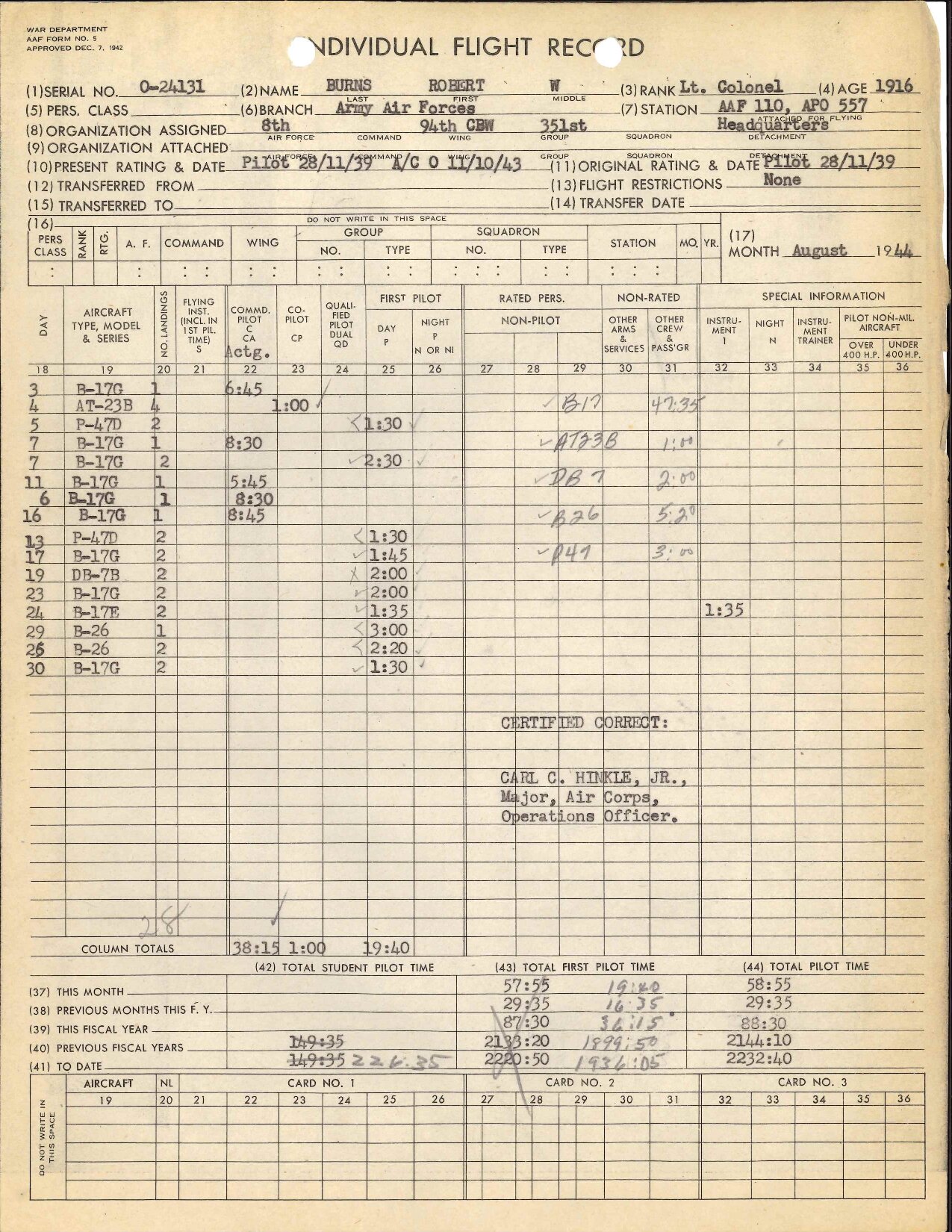
August 1944 Form 5 — among these local flights are Bob’s personal checks of aircraft that crews had aborted.
Bob’s policy was to personally fly any aircraft a crew had aborted. Those check flights appear throughout his Polebrook forms as short local entries — unannotated, but exactly where the story says they would be.
View all flight records →