Towing Targets at 1,500 Feet
The Canal Zone in 1940 was a strip of sovereign American territory about ten miles wide (five miles on each side), bisected by the canal itself and guarded by a constellation of Army posts, naval stations, and airfields. France Field, on the Atlantic side near Colón, was home to Bob's unit: the 7th Reconnaissance Squadron. In addition to its cameras, photo lab, and long-range patrol mission, the 7th was also capable of serving as a bomb squadron — a flexibility that the pre-war Air Corps expected of all its units.
One of the regular duties at France Field was towing aerial targets for the Coast Artillery posts that ringed the canal approaches. The artillery had to stay sharp; the airmen had to provide them something to shoot at. It was unglamorous work — low altitude, slow airspeed, hot sun — but it fell to whoever was on the schedule.
Bob's squadron commander was Captain Guy F. Hicks, a man with over twenty years of service and a well-earned reputation as a "character." On the morning in question, Hicks and Bob were the crew.
The Mission
"One task that we had at France Field, was to tow targets for the Coast Artillery post for their anti-aircraft practice. Hicks and I were on a towing mission. It was flown at about 1500 feet and it was hot. Both Hicks and myself had taken off our shirts and laid them on the navigator's table just behind us in front. There was a hatch just behind the pilots seats which could be opened and this was the case this morning. Hix asked me to get his sunglasses from his shirt pocket. I reached behind me and as I brought the shirt toward me, it got sucked right out of my hand. Hicks simply reached back and got my shirt and tossed it out the hatch. I was restricted to eating in the mess kitchen for a day until I could get a new shirt."
The logic, from Hicks's perspective, was unassailable. Bob had lost government-issue property — his shirt — through negligence (or at least aerodynamic misfortune). Hicks's own shirt had gone out the hatch through no fault of his. If one officer was going to be shirtless, both officers would be shirtless. Equity demanded it.
The Air Corps held its personnel responsible for their issued equipment. Appearing on base without your shirt — particularly when you had been the one flying — was a violation that warranted some corrective action. Bob got his: a day of eating with the kitchen staff rather than in the officers' mess. He did not record whether Hicks shared the punishment.
Life at France Field
The target-towing mission captures something essential about the Canal Zone posting in 1940: the combination of genuine responsibility — guarding one of the world's most strategically critical pieces of infrastructure — and the day-to-day texture of garrison flying in the tropics, which could be both tedious and absurd.
Bob arrived at France Field in December 1939 fresh from flying school. The 7th Recon flew B-18s on long patrol legs and managed the photo and reconnaissance mission for the Canal Zone Air Force. But on days when the Coast Artillery needed targets, you put on your shirt, walked out to the flight line, and did the job — or in this case, flew without your shirt and regretted it.
The B-18 Bolo was the Douglas-built bomber that preceded the B-17 in Army Air Corps service. Derived from the DC-2 commercial airliner, it was already being supplanted by the B-17 by 1940 — but it remained the workhorse of the Canal Zone's 7th Recon Squadron throughout Bob's early service. He would log hundreds of hours in B-18s before transitioning to the B-17 in late 1941.
From the Flight Records
From the records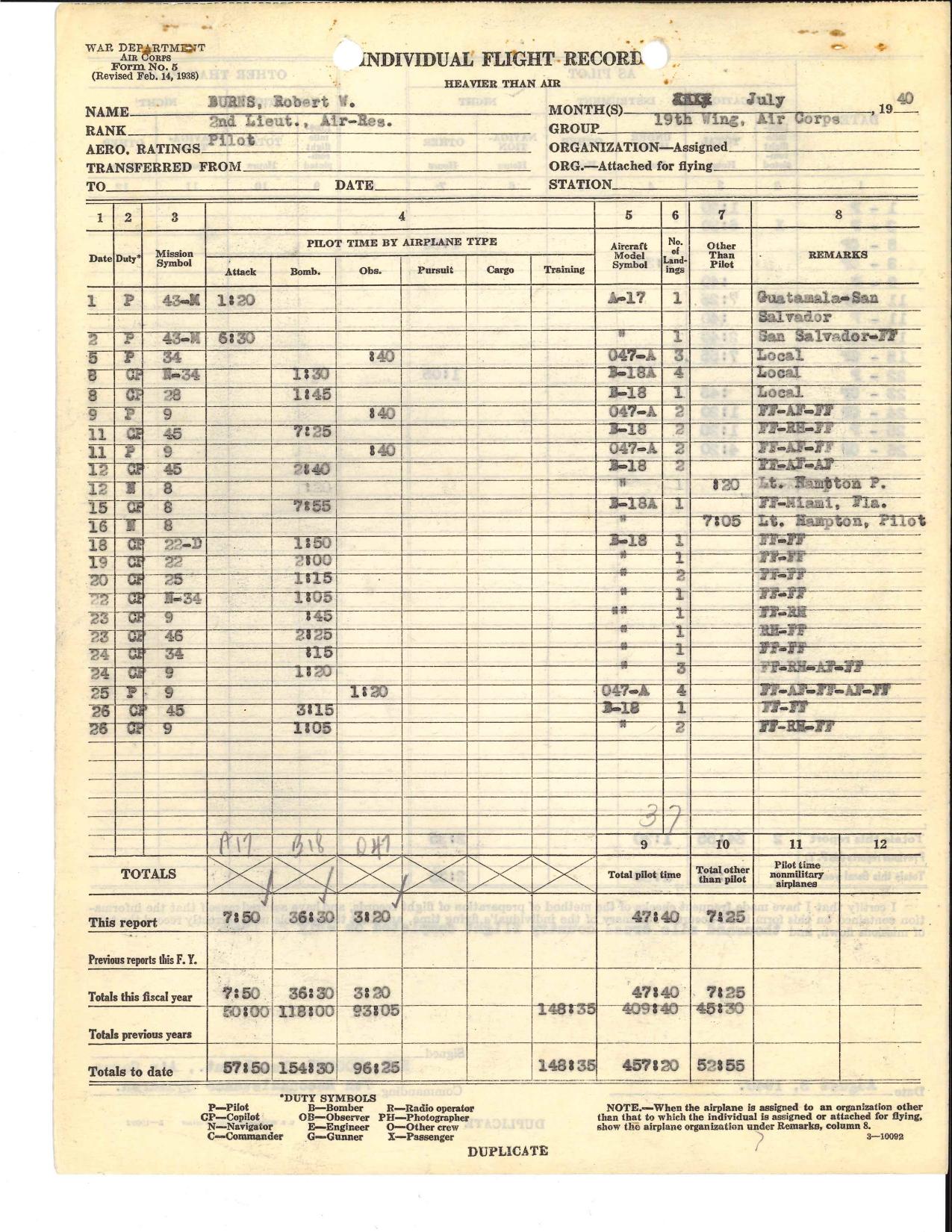
July 1940 Form 5 — B-18 flying at France Field under Capt. Hicks’ 7th Reconnaissance Squadron.
The 1940 forms record aircraft and hours but rarely a flight’s purpose — a towing sortie looks like any other B-18 line. The squadron, station, and aircraft all match the story’s frame.
View all flight records →