The Request to Leave
By mid-1940, Bob Burns had been flying out of France Field in the Panama Canal Zone for the better part of a year. The 7th Reconnaissance Squadron patrolled the jungle approaches to the canal — useful work, but hardly glamorous, and conducted in the relentless tropical heat of the pre-air-conditioning era. When he heard from an old roommate who had left the service and found himself flying for Eastern Airlines between Memphis and Miami, the contrast was hard to ignore.
"About June of 1940, I had word from my old roommate that he was employed by Eastern Airlines and flying between Memphis and Miami. This struck me as a lot more enjoyable than flying over the jungles of Panama in a very uncomfortable climate. Remember that this was in the pre-air conditioning era. So I sent in my request to be relieved from active duty. In about a month later, I got a letter from Washington, inferring that I must not have been reading the newspapers. It seems that the President had declared a national emergency and nobody was being released."
France had fallen in June. The Battle of Britain was underway. The national emergency Roosevelt had declared was not a formality.
The Thomason Act
"Now I am caught up in a dilemma; staying in a reserve capacity would mean that I could be retained for several years and then cast adrift at the convenience of the Government, or I could decide to become a regular and have a career guaranteed if there was no major screwup. At this time, there was a law known as the Thomason Act which let the Air Corps select thirty individuals for regular commissions. The selection method was a four hour examination on navigation and aircraft engines. Then an appearance before a board which would rank those appearing as to fitness to be selected. In short, I was one of the 30 nationwide to get one of these commissions."
The Thomason Act (formally, the Act of August 30, 1935) allowed the War Department to appoint reserve officers to permanent commissions in the Regular Army. Only a handful of vacancies were allocated to the Air Corps each year, making selection fiercely competitive. For Bob, passage meant the difference between an uncertain wartime tour and a guaranteed career.
The Cost of the Commission
"But I automatically became the junior lieutenant in Panama because my status had changed. At the time, I considered this to be a minor matter since seniority among my classmates had little significance anyway. But with Pearl Harbor, this became a different matter."
When Japan attacked Pearl Harbor eighteen months later and the Army Air Forces expanded at a speed the country had never seen, every notch of seniority carried real weight.
Why It Mattered
The Thomason Act commission shaped everything that followed. While reserve officers faced genuine uncertainty about their futures — some were released, some retained, their careers subject to the shifting needs of a bureaucracy at war — Bob had a guaranteed career path. He knew where he stood. He could plan, advance, and command with the authority that a regular commission conferred.
The seniority penalty was real, and Bob never minimized it. When classmates who had kept their reserve seniority moved up promotion lists faster in the early war years, the disadvantage was felt. But the commission itself proved its worth: Bob went on to command the 351st Bomb Group through the most intense period of the air war over Germany, eventually retiring as a Major General in 1970 after thirty-one years of service. None of that was possible without the decision made in Panama in the summer of 1940 — the year he tried to leave and instead chose to stay.
From the Flight Records
From the records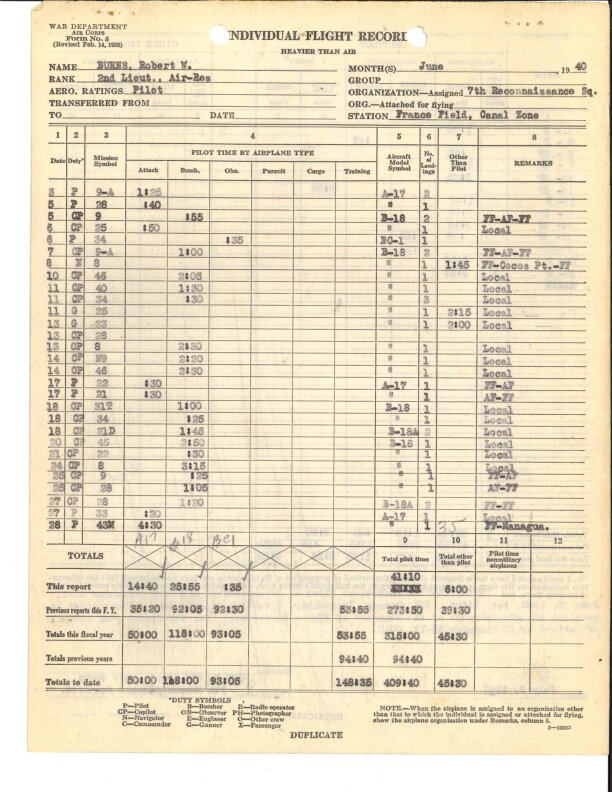
June 1940 Form 5 — the month of the Thomason Act examination, flown around the studying.
The exam month is documented here; the prize is documented in his 201 file — Personnel Orders No. 153 of July 1, 1941, listing the Class 39-D men who received one of the thirty Regular commissions, with Bob’s name checkmarked on the original.
View all flight records →