Orders to Spokane
After months flying long-range B-17 patrols out of Guatemala City to the Galapagos Islands, Bob Burns arrived in Spokane, Washington, in late November 1942 with orders to report to the 351st Bomb Group. The 351st was a new unit — it existed mostly on paper, a collection of officers tasked with building a heavy bombardment group from scratch. Bob found them in a barracks building on the edge of Geiger Field, which also served as Spokane's municipal airport.
The Forming Group
"I arrived in Spokane, Washington, in late November and found my way to the Hqs. of the 351BG. It was in a barracks building on the edge of the airport, Geiger Field. Also the municipal airport for Spokane. Already collected there were a few souls, one of which was William Hatcher. He was a Lt. Col. just relieved from his previous assignment at an Army post, Ft. George Wright, on the edge of Spokane. I don't know what his job was there but he was totally occupied with putting a bomb group together. My counterpart, the Ground Exec, Bob Bowles, was there as was the group Operations officer, Ross Milton, a West Point grad. and later a 4 star Gen."
Ross Milton, the Operations officer Bob mentions, did go on to wear four stars.
Bob came to Spokane with something most of his new colleagues lacked: hundreds of hours of first-pilot time in the B-17, accumulated on those grinding Galapagos patrol flights where no navigators or bombardiers were aboard and the pilot flew everything himself. That experience made him the natural choice as Air Executive — Hatcher's second-in-command for all flying matters.
Flying Together
Hatcher wanted the group in the air as much as possible. With only a handful of aircraft on the ramp at Geiger, they flew formation flights to other bases and used every opportunity to build cohesion and proficiency. Not all of it went smoothly.
"Willie thought we ought to be flying as much as possible, and we made a couple of 6-ship formations to various bases, and one flight had us overnighting at Salt Lake. The ships were parked on a new slab of concrete and one had gotten too close to the edge of the pavement and dropped the tail wheel off a two foot slab of concrete. I was called to scene and quickly found out that there was no machinery available to lift the bird. Then I had an idea. I got in the cockpit and started all four engines, holding the brakes hard, I ran the engines up to a pretty good speed and pushed forward on the wheel, lifted the tail clear of the concrete edge, rolled a couple of feet and shut it down."
In 1942 the infrastructure of a mature air force hadn't yet caught up with the rate of expansion. Problems got solved in the field.
The group eventually moved south to Biggs Field at El Paso, Texas, where Hatcher continued to push the formation flying hard. On one afternoon return from Blythe, California, the group hit a solid wall of weather.
"On the afternoon return to Blythe, late in the afternoon, again in formation, we hit a solid wall of weather. the drill in such a case was for the lead flight to enter the weather with the right wingman climbing a thousand feet and the left wingman descending thousand feet but going on course. the second flight, mine, was to do a 360 degree turn and repeat the procedure. Well, the ride through this stuff was a mighty rough ride. I had to brace myself with one hand and fly with the other. Over Phoenix, now totally dark, I could make out the city lights below and it crossed my mind to land there and wait for better weather, but I also thought that Col. Hatcher would no doubt go on to Biggs, and I surely didn't want to not be able to do so myself, so I plowed on. And it got worse but I did get out of the weather some little distance short of Biggs. On landing, I found that Hatcher and I were the only two planes to get there. You can bet that I was mighty glad that I had plowed on to Biggs. And I think Willy appreciated my demonstration too."
Who Willie Was
"Becky, only us underlings referred to Col. Hatcher as Willie. And so far as I know, never to his face. He was a serious man in everything and expected the same attitude in all of us. He was in his 30's, I think, at that time. I have no idea what his background was, but he was in control of that group and he expected those of us who had responsibilities he delegated, to treat them the same way. And we did."
The 351st departed for England in the spring of 1943.
The 351st Bomb Group flew its first combat mission from Polebrook, England, in May 1943. By the end of the war it had flown 311 missions and logged more than 8,000 combat sorties. Hatcher led the group in its early combat operations. Bob would eventually take command himself.
The End of an Era
The partnership between Hatcher and the group he had built in those spartan barracks at Geiger Field was cut short at year's end. The 351st was in England, flying against targets across occupied Europe, when the calendar turned.
"And to keep the time table straight, on the 31 Dec. 1942, Willie and a few others of the group were shot down on a mission to southern France."
A slip of the calendar in Bob’s telling: Col. Hatcher was shot down on December 31, 1943 (the 8th Air Force mission toward the Cognac–Bordeaux area), not 1942 — the 351st did not reach England until April 1943.
From the Flight Records
From the records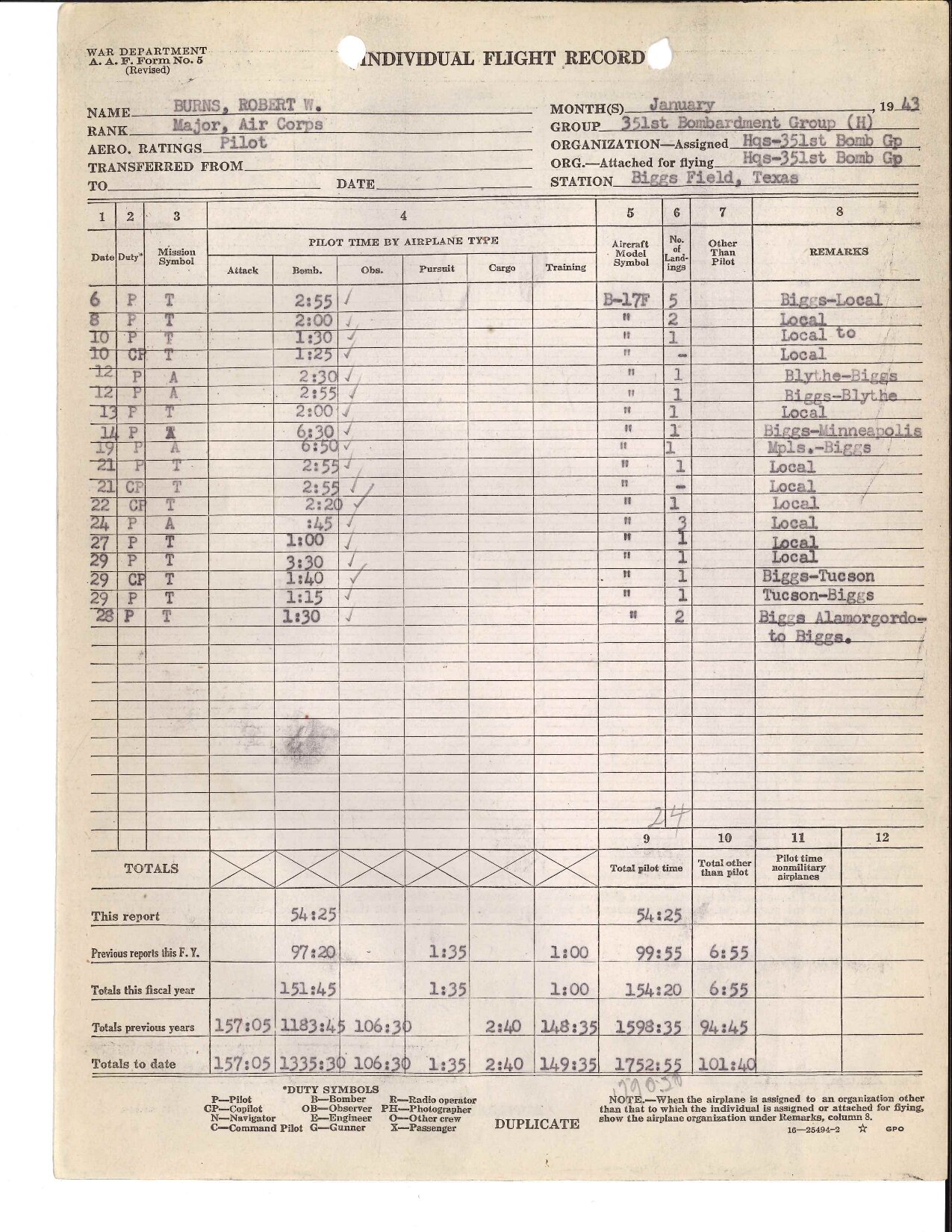
January 1943 — Individual Flight Record (Form 5), Biggs Field. The January 11th entry reads "Blythe-Biggs" in the notes column.
The form itself names the route — Blythe to Biggs — matching exactly the weather return Bob described. January 11, 1943 was when the group was based at Biggs Field, El Paso, the period Bob places the Blythe story. The two-and-a-half-hour duration for a ~200-mile flight in winter weather is plausible if Bob was navigating IFR much of the way. Notably, February 1, 1943 shows three Blythe-Biggs entries in a single day (210 min outbound + two 180–210 min returns), which may reflect multiple aircraft making separate instrument approaches — consistent with Bob's account that he and Hatcher were the only two who completed the trip.
View all flight records →