United States Army Air Forces · United States Air Force
Major General
Robert W. Burns
December 8, 1916 – February 6, 2004
31 Years of Flight · 1939–1970 · 7,451 Hours
Robert Wiygul Burns — “Bob” to everyone who knew him — was born December 8, 1916, in rural Mississippi. He earned his wings at Kelly Field on November 28, 1939, and for the next thirty-one years he flew for the United States Army Air Forces and the Air Force that grew out of them: B-18 patrols over the Panama Canal, B-17s against occupied Europe, Guard Thunderbolts over Tennessee, jet interceptors above the Pacific Northwest, and finally a general's T-39 — the only aircraft in his last year's logbook.
This archive is his family's effort to preserve that life whole. At its core are his complete Individual Flight Records — every monthly Form 5 from June 1939 to July 1970, scanned, transcribed, and cross-checked — surrounded by the things the records can't say by themselves: the stories he wrote for his family in 2003, his photographs, his personal 16mm film from Polebrook, recorded interviews, and the documents of a long career.
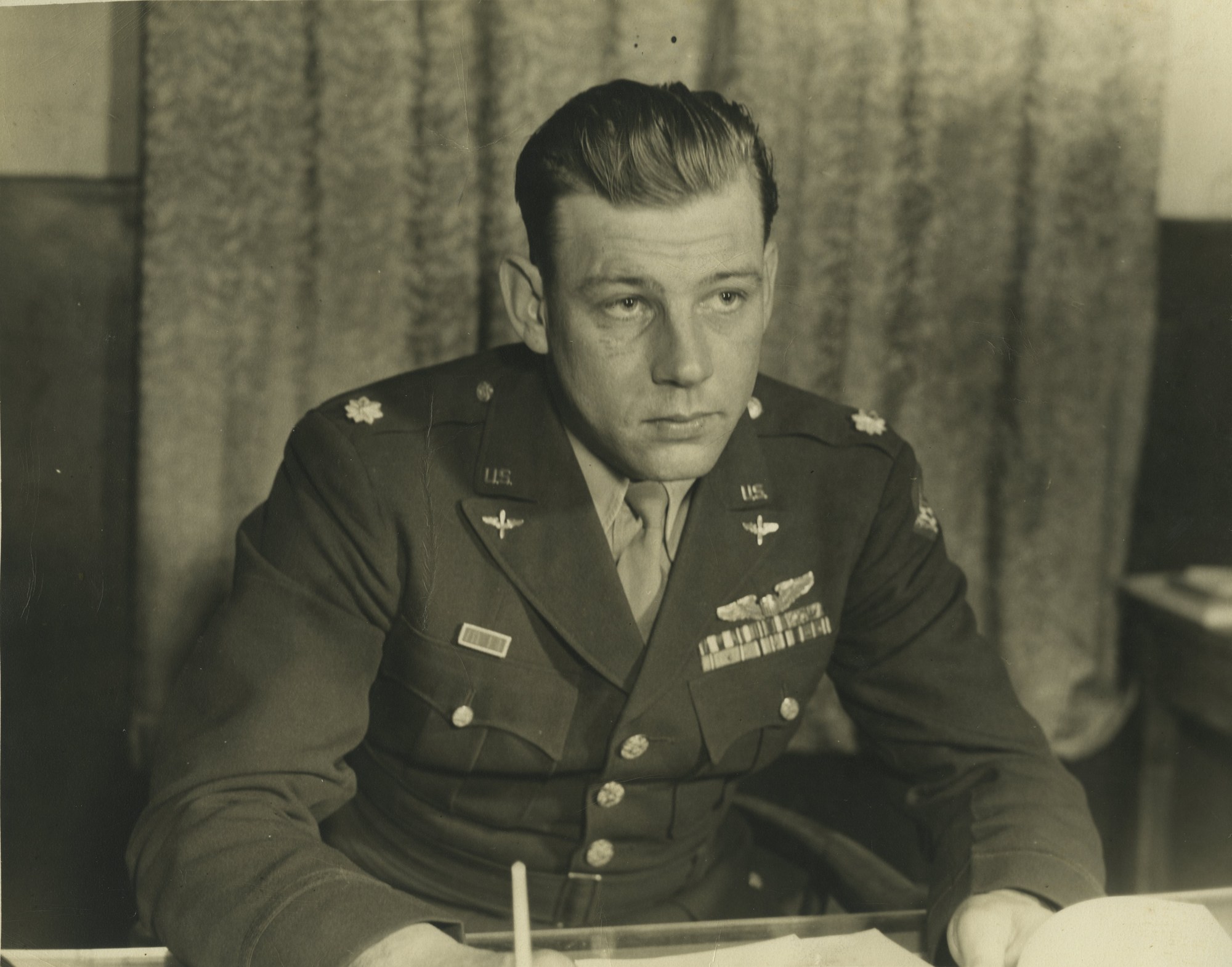
In WWII Bob served as Group Air Executive of the 351st Bomb Group (H) at RAF Polebrook, England, flying combat missions over occupied Europe before assuming command of the Group on October 12, 1944. He came home a 28-year-old colonel; twenty-five years later he retired a Major General.
WWII Decorations: Silver Star • Distinguished Flying Cross with oak leaf cluster • Air Medal with 3 oak leaf clusters • European-African-Middle Eastern Campaign Medal with 2 bronze stars • American Campaign Medal (with Bronze Star device — anti-submarine duty, Canal Zone) • American Defense Service Medal • World War II Victory Medal
“When my watch came to the minute, I signaled that we were there. With this, the pilot rolled into a 90 degree bank and, lo and behold, the base was directly under us.” Bob Burns, on dead-reckoning navigation over Panama, 1940 — from the Morning Reports
Each chapter pairs his own account with the flight records that corroborate it. Hours and flights below are computed from the digitized logs.
Randolph and Kelly Fields, Texas. Class 39-D: from cadet to rated pilot in five months.
B-18 and B-17 patrols guarding the Panama Canal; Pearl Harbor night at Howard Field; Galapagos anti-submarine runs navigated by whitecaps.
Forming the group, the Atlantic crossing, Schweinfurt, the Silver Star at Nantes, command at Polebrook — with Clark Gable in the nose turret.
Thirteen assignments on three continents: Tennessee Guard P-47s, McChord interceptors, Athens, Karachi, the Pueblo crisis — and two stars.
In the summer of 2003, at 86, Bob wrote his flying life for his family in daily “Morning Report” emails — and Ruth wrote too. Their own voices are the soul of this archive.
Pearl Harbor at Howard Field. The string on the wall before Schweinfurt. A Piper Cub to Wales to see Ruth. Ice cream frozen at 18,000 feet.
“Mamu’s” own letters, 2003–2005 — watching over Bob in his last year, and carrying on after. Warm, funny, unguarded.
A family cassette: his daughter interviews him about his life and career. With full transcript.
Bob on flying with Clark Gable at Polebrook, recorded for Cincinnati radio. With full transcript.
His personal 16mm footage of the 351st at war, digitized, with annotated timecodes.
The documentary spine of the archive: his complete flight records, digitized and queryable.
Jun 1939 through Jul 1970 — every surviving monthly Form 5
Beyond the logbooks — the photographs, documents, and artifacts of a flying life.
From cadet days to retirement, annotated by the family: cockpits, ceremonies, Karachi, Korea, and both star-pinnings.
Biographic memoirs of the men who earned their wings beside him at Kelly Field, compiled in 1983.
His decoded IBM personnel punch cards, c. 1968 — a career as the Air Force's computers saw it.
Sixty-three press clippings, 1933–1970 — read against the records, with the papers’ errors marked and corrected.
A guide to the Individual Flight Record — the fields, codes, and conventions behind every page here.
This is a family digitization project, begun by Bob's grandson with records Bob set aside before his death in 2004. Every statistic on this site is computed from the digitized records themselves; every story is in Bob's own words. Data, images, and source documents are preserved in a public GitHub repository for long-term preservation.
Read more: about the archive · how it was built with AI · site map