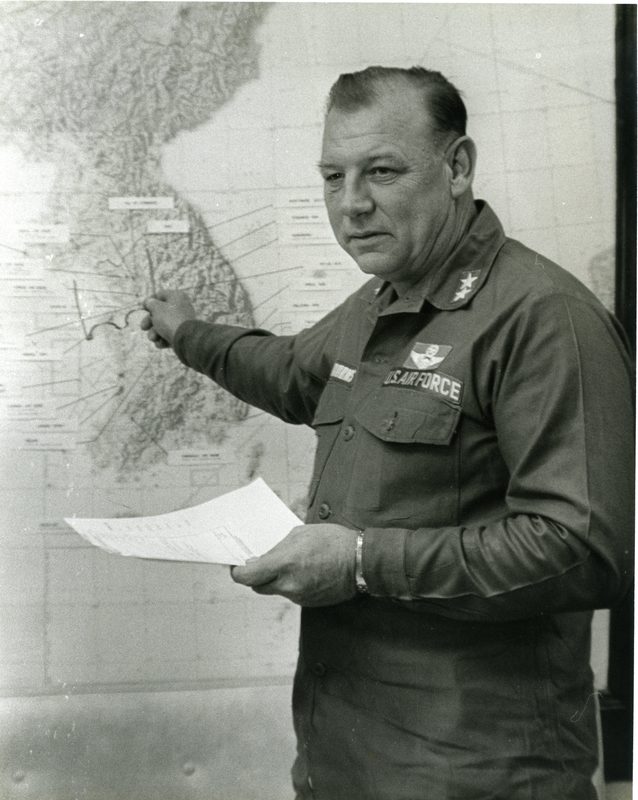
On January 23, 1968, North Korean vessels seized the USS Pueblo, a Navy intelligence ship, on the high seas and took her crew prisoner. For most Americans it was a headline. For Bob Burns, it was the phone call that ended a vacation after dinner and put him over the Pacific by morning.
A Leave in Orlando
Bob, commanding the 19th Air Force, had arranged some leave: he and Ruth would meet friends, Dan and Louise McClain, at Orlando, where they had reservations at the BOQ. He was careful about it — when the Pueblo news broke, he actually phoned his headquarters at Langley to ask whether he ought to hold off.
They told him not to worry. So he and Ruth drove down to Orlando, and the McClains were there, and they had dinner. (Bob, telling this in 2003, placed the seizure “about Thanksgiving” and added, characteristically, “You can look up the date.” It was late January.)
The Phone Rang
After dinner they were sitting in their room when the telephone rang. It was his boss, General Disosway.
“He asked if I had my airplane there and I told him no. He then said for me to get it there post haste because I was to leave S[eymour]-Johnson the next morning for South Korea. It seems that the H[ead]q[uarter]s. USAF had decided that my 19th Air Force would be just the agency to handle the air force deployments to Korea.”
He called the base, confirmed his airplane was already on its way to Orlando, drove home, and packed. There was no time for anything else — including getting his wife home.
“I had to leave Ruth to drive home by her self and she did.”
He spoke with Becky, and Sue was there too, telling them what was happening. At about eight the next morning he lifted off for Osan, South Korea — with fuel stops in California and Hawaii.
Plywood and Two Air Bases
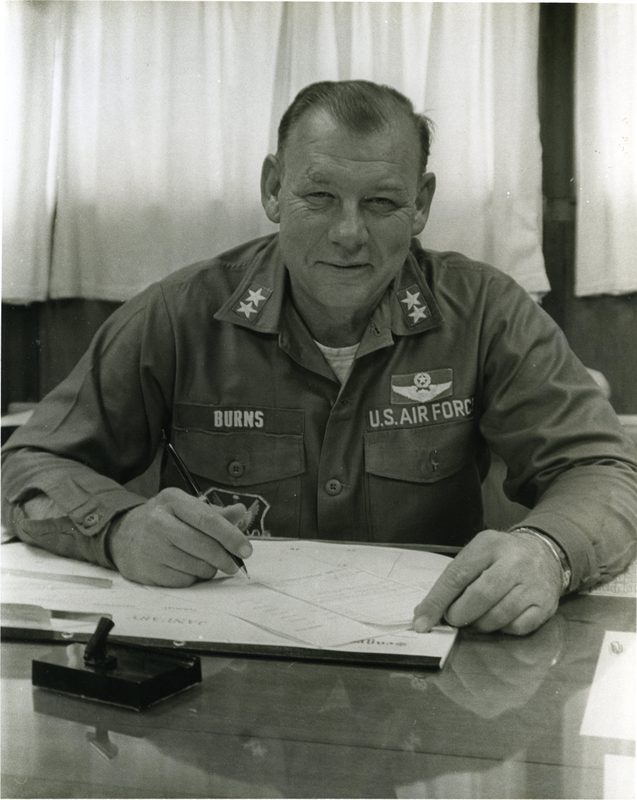
In Korea the work was relentless at first: receiving Air Force squadron after squadron and getting them based. Bob credited the unglamorous hero of the operation — his civil engineer.
“Fortunately, I had a good civil engineer on the staff and he knew how to get plywood and how to get it put up. He rehab[b]ed two air bases and our troops moved in.”
But once the augmented force was bedded down and operational, the shape of the bureaucracy revealed itself. His units fell under the operational control of 5th Air Force back in Japan, which already had a headquarters extension in Korea. His own small headquarters, he realized, was simply redundant — and, like his bosses back in Tampa, 5th Air Force was reluctant to give up an asset, even an idle one.
Golf, and the Chiangs
So a major general found himself with time on his hands in a war scare. He filled it the way Bob filled most spare hours.
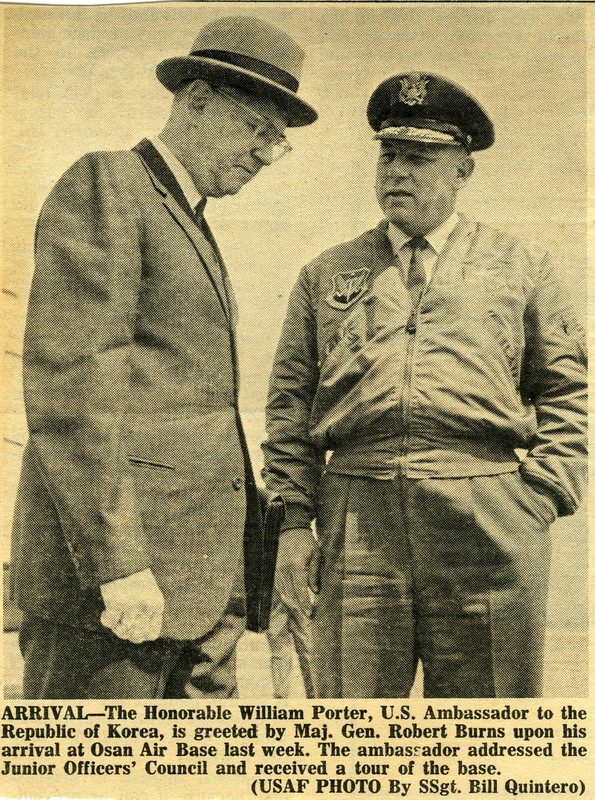
“To take up some time, I took a chopper up to S[e]oul and played golf pretty regularly and I did get a trip down to Taipei where the ambassador, who had been in Pakistan with me, arranged a fine dinner with the local military troops and a delightful meeting with Madam and Generalissimo Chi[a]ng. He didn’t have much to say but the Madam was very interested in what was happening in Korea.”
It is a remarkable aside delivered in passing: dinner in Taipei with Chiang Kai-shek and the formidable Madame Chiang — she doing most of the talking, keenly interested in the Korean situation; the Generalissimo, as Bob remembered him, mostly quiet.
Relieved by a Commission
The way out of Korea, when it finally came, was the most personal orders he ever received. The Chief of Staff of the Air Force invited him to award commissions to the graduating cadets at West Point — and the reason he, specifically, was asked is the whole point.
“Andy was one of them. Which is why I was invited to do this duty in the first place.”
His son was graduating. Bob flew home from a redundant headquarters in a war zone to stand at West Point and commission his own boy into the Army — and in doing so, finally got himself relieved from Korea. The general who had been sent overseas by a phone call after dinner came home to pin bars on his son.
From the Flight Records
From the recordsThe trans-Pacific deployment falls in his final batch of flight records (1960–70). His logbook for early 1968 carries the long over-water legs and the Korea-based flying this story describes; the career page The Pueblo Incident sets it in context, and the full era is in Cold War & Command.