The T-39 Arrives
By the early 1960s Bob Burns was commanding an air division at Tyndall AFB on the Florida panhandle. The job came with a new aircraft: the North American T-39 Sabreliner, a twin-jet executive transport that had entered service just a few years earlier. It was sleek, fast, and capable of altitudes the lumbering transports of the war years could never have reached. Bob was delighted.
"And along with the job came a new T-39, a North American twin jet transport. Joy of joys."
The T-39 Sabreliner had a ferry range of roughly 1,800 to 2,000 miles depending on load and altitude. Bob put it to work immediately — and then some.
A Push for Non-Stop
The trip to Hamilton AFB in northern California was a regular run — Hamilton was a major Air Force installation, and business took Bob there regularly. What made one return flight unusual was the hour of departure and a question he decided to answer.
"On one trip to Hamilton AFB, I decided to come back to Tyndall after a dining-in. It was fairly late at night and clear. We climbed up to about 39,000 feet and were going to try to make Tyndall non-stop. As we burned off fuel, we climbed to 41k feet, getting the fuel consumption way down. Somewhere around Oklahoma City, Andy Andreason began to really use his computer to see if we might make it all the way. Of course there were plenty of places to stop at if we needed them, but we pressed on."
Andy Andreason was Bob's aide.
The Descent
"I stayed at altitude to the last minute before starting down to land at Tyndall. The descent was pretty steep and I flamed out the right engine because the fuel was so low and the down angle so steep that air instead of fuel was going to the engine. I eased off the descent and we restarted the engine and landed at Tyndall with just enough fuel left to taxi into the hangar. Andy was exhausted with his continuous calculation of fuel and distance and I was a bit tired myself, the T-39 having no autopilot."
The direct distance from Hamilton AFB, California to Tyndall AFB, Florida is approximately 2,100 miles — beyond the T-39's standard fuel range.
More Than a Transport
"I decided to take advantage of my situation, and got my Masters degree from a branch of George Washington University, located at Maxwell Field, Ala. I flew up once a week for a three hour session, then flew back to Tyndall. I really put some time on that T-39."
Maxwell Field is in Montgomery, Alabama — roughly 250 miles from Tyndall. The round trip in the T-39 took less time than the drive would have taken one way.
There was also a night flight back from the northeast — at altitude, with his son Andy in the cockpit beside him.
"On one trip from there to here, we flew in the T-39 and Andy was in the cockpit with me. It was a clear night and at our altitude, you could see the lights of Boston, New York, Baltimore and Washington in a single glance. Spectacular."
Bob had learned to navigate over dark ocean by reading whitecaps and wind streaks. He remembered those city lights sixty years later.
From the Flight Records
From the records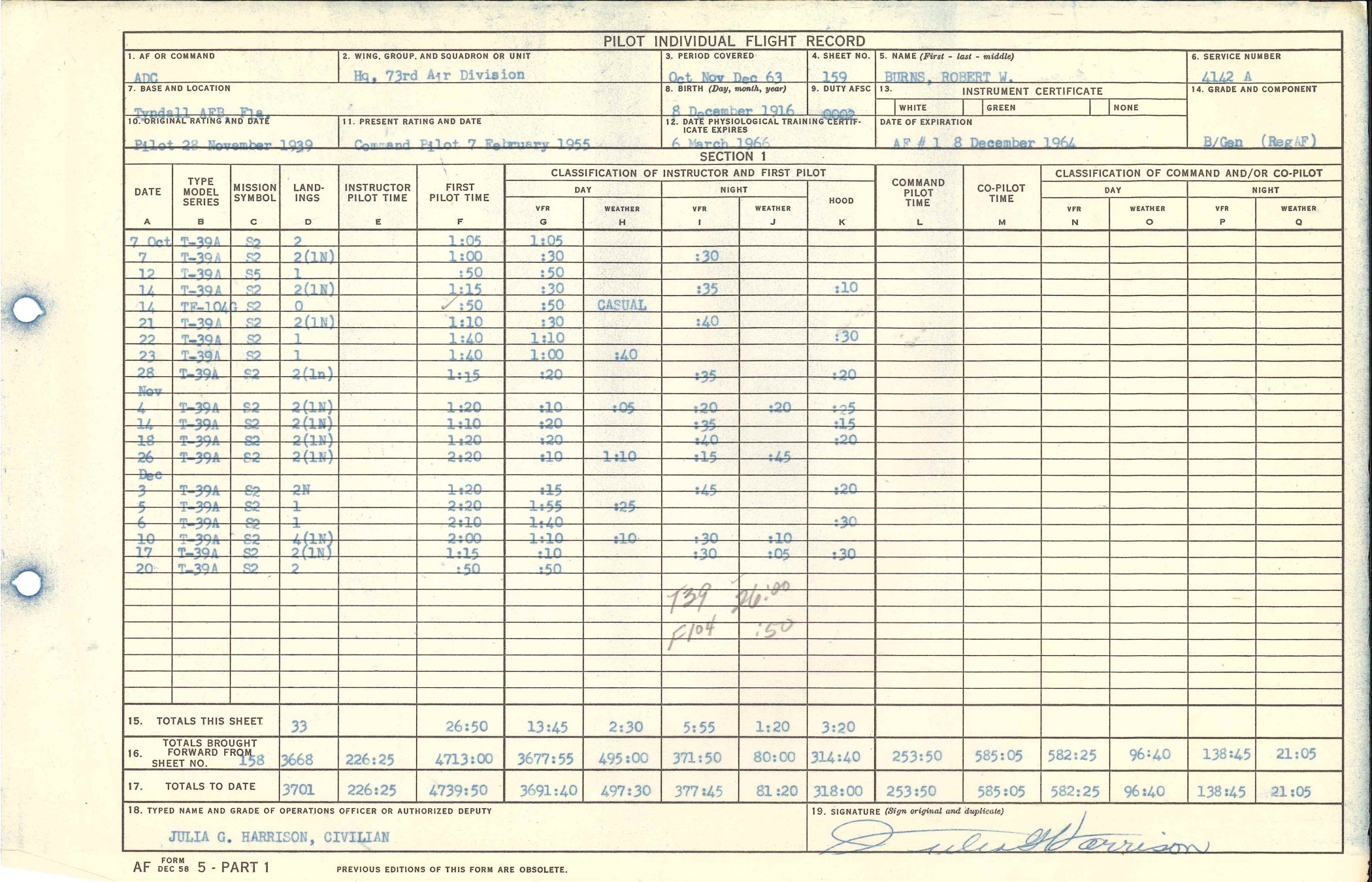
Jan–Mar 1964 quarterly Form 5 — T-39 flying in the division-command years, including a four-hour single-landing night leg.
The forms of 1962–65 are full of long T-39 legs; this one — four hours, one landing, flown mostly in darkness after an evening departure — is the closest match to the non-stop Hamilton–Tyndall run. The flame-out on descent went, naturally, unannotated.
View all flight records →