Of all the things Bob Burns lived through in the war, the scene he returned to with the most feeling was one he watched from the ground. A crippled B-17 came home to Polebrook flown by men who were not pilots, carrying a dying captain they would not abandon. He told it to Nick Clooney sixty years later, and he was still arguing with it.
The Fortress That Came Back Wrong
It was a mission Bob did not fly — he was in the control tower that day. The group came home and the airplanes landed, one after another, until one more appeared: a B-17 coming in low and wrong.
As the account reached the tower, the ship had been hit hard. One of the two pilots was dead; the other was unconscious, gravely wounded, but still alive. There had been a fire in the cockpit. And the Fortress was being flown — barely — by the navigator and one other crewman, men with no training to land a four-engine bomber.
“We Begged Them All to Bail Out”
From the ground they pleaded with the crew over the radio: put a parachute on the wounded man, get him out of the airplane, and the rest of you jump — we will take care of him when he lands. The two at the controls refused. They were going to bring the captain home alive, or not leave him at all.
“We begged them all to bail out — to put a parachute on [the] fellow who was still living, full of gore, and throw him out, and we’d take care of him on the ground. But they just… refused to do it. They weren’t gonna do it.”
They made a pass at the runway. They had no concept of how to fly an approach and landing.
Into the Same Air
So Bob — deputy group commander — and the group commander each took up a B-17 and went after them, trying to fly close enough to lead the stricken ship down, to “bleed them into” a landing. It could not be done. The crew at the controls could not hold position; they were a danger now to the very planes trying to save them.
“They just couldn’t stay in the same… didn’t know how to be in the same air with another airplane.”
In sheer desperation, the crew turned away to look for an open field — somewhere big enough to set the airplane down themselves.
An Open Field
They found one, and they put it on the ground. For a moment it was rolling out, going along well enough. Then a wheel or a wingtip caught a rise in the ground — a little hillock — and the Fortress upended, cartwheeled, came apart, and burst into flames.
The one mercy in it: before they tried to land, the two men had made certain the rest of the crew bailed out and came down safe under their chutes. Only the two who stayed at the controls — and the captain they would not leave — were still aboard. They died at once.
“You Got to Salute Those Guys”
Sixty years on, Bob held two things in his mind at the same time, and would not let go of either. The first was awe.
“You got to salute those guys… They were absolutely… heroic beyond all reason.”
The second was a commander’s grief, and a quiet dissent he never softened — that the bravest thing might also have been the wrong call, and that the men, the captain, and the airplane were all lost when some of them might have lived.
“But again, it was, to me, just… loss of life that really just shouldn’t have happened. Shouldn’t have occurred. They should have done what they could to get the unconscious man out in a parachute… and then bailed out themselves.”
That he could honor the courage and still mourn the waste — could salute the men and disagree with what they did — is exactly the kind of clear, unsentimental judgment that made him a commander. He carried the picture of that burning field for the rest of his life.
Eighty Years Later: a Ship, a Date, and Two Medals of Honor
For years this page ended with a request — the names Bob recalled on the recording were unverified, and the archive asked anyone who could identify the crew or the date to write in. In June 2026, Doug Palmer did. Doug, an administrator of the 351st Bomb Group’s memorial community and son of 2nd Lt. David H. Palmer — the co-pilot who flew the Nantes mission with Bob — supplied the identification, and the published record confirms it.
The ship was B-17G 42-31763, “Ten Horsepower,” of the 510th Bomb Squadron, lost on February 20, 1944 — the opening day of “Big Week,” on the group’s mission to the Leipzig area. A 20mm cannon shell exploded in the cockpit, killing the co-pilot instantly and gravely wounding the pilot, Capt. Clarence R. Nelson. The two men who took the controls were the navigator, 2nd Lt. Walter E. Truemper, and the engineer and ball-turret gunner, Sgt. Archibald Mathies. Bob, speaking from memory sixty years on, gave their names as “Trumpeter and Mathis” — nearly letter-perfect.
And the published record names the pilots who went up to try to lead them down: the group commander, Col. Eugene A. Romig, and Lt. Col. Robert W. Burns — exactly as Bob described it, told from the other side of the record. (Other tellings also place Maj. Elzia Ladoux, commander of the 509th Squadron, in the air alongside them; more than one Fortress went up that afternoon.) After the crash, Truemper and Mathies were each posthumously awarded the Medal of Honor — to this day the only two in the history of the 351st Bomb Group.
The full story is told in Valor at Polebrook: The Last Flight of Ten Horsepower by Rick School and Jeff Rogers (Cross Roads, 2000), a copy of which is held in the archive’s collection; see also the aircraft’s page at the American Air Museum in Britain.
From the Records
From the records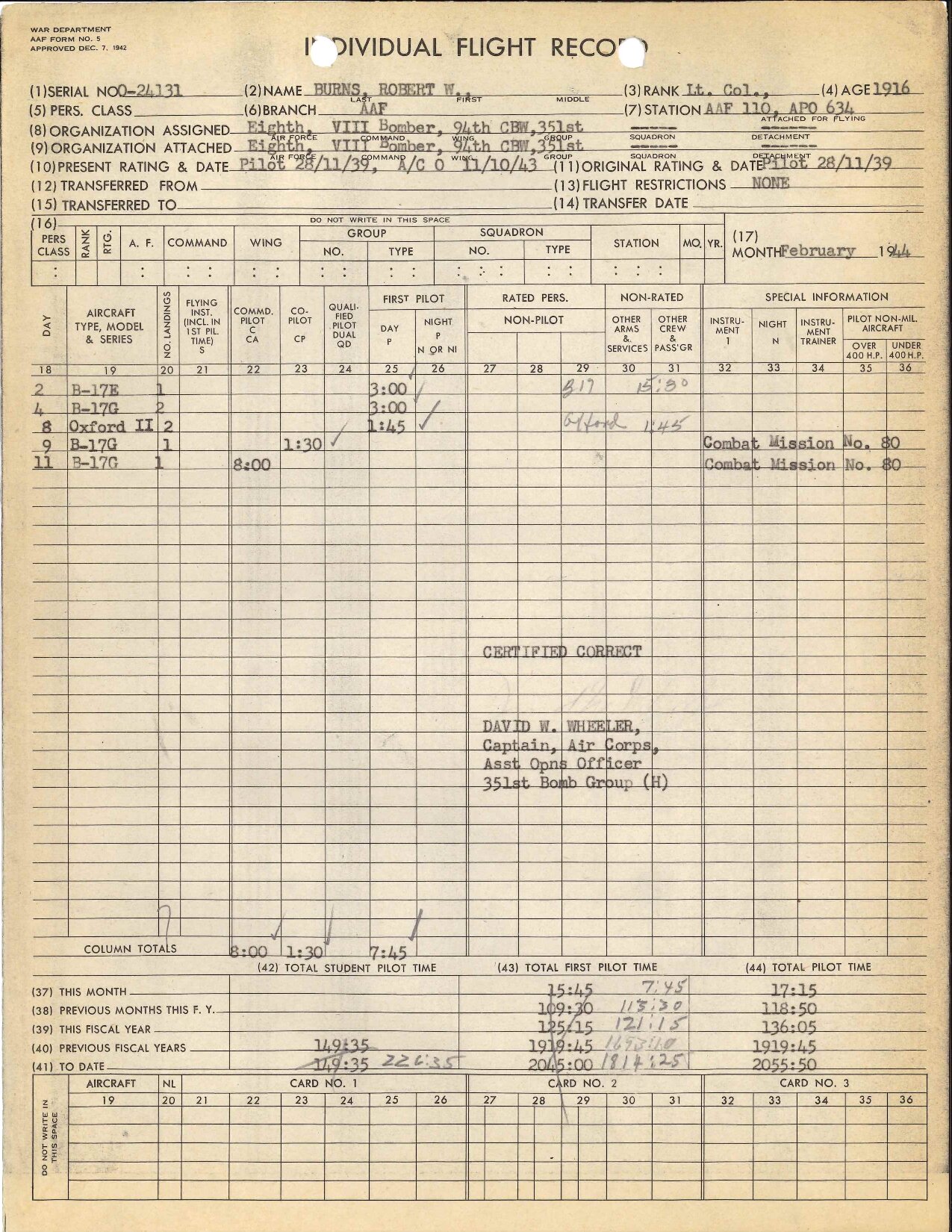
Bob’s February 1944 Form 5 places him at Polebrook flying B-17s that month — and, tellingly, shows no logged flight on February 20. His last logged February flight is the 11th, and the form’s printed totals match its entries exactly, so nothing is missing: the desperate flight he describes here — going up to try to lead Ten Horsepower down — simply never made it into his log. It survives instead in the group’s record: the published accounts of February 20, 1944 name Col. Romig and Lt. Col. Burns as the pilots of the two guide aircraft. An unlogged flight, corroborated from outside the logbook — the reverse of most stories on this site, and worth stating honestly.